From Service to Scale: Can Selling Templates 10x Your Freelance Income in 2025?
Stop trading hours for dollars. It’s the mantra we all hear, but as freelancers, we often find ourselves trapped in the “golden handcuffs” of high hourly rates with zero leverage. You stop working; the money stops flowing. I’ve been there—staring at a calendar fully booked with client meetings, realizing my income had a hard mathematical ceiling.
But the landscape is shifting rapidly. While you sleep, the “Creator Economy” is exploding. According to a 2024 report by Goldman Sachs, the total addressable market of the creator economy could roughly double in size, approaching $480 billion by 2027. For freelancers, this isn’t just about becoming an influencer; it’s about claiming a slice of that market by selling digital assets.
This is the definitive guide to shifting from 100% service work to a hybrid model (Service + Products) using 2025 market data. We aren’t just talking about “passive income” fluff; we are talking about scalable, legal, and technical execution.

The “Hybrid Freelancer” Model: Why Templates Are Essential in 2025
The old binary of “Employee vs. Freelancer” is dead. The new dominant force is the “Hybrid Freelancer”—someone who provides high-end services to select clients while selling the systems used to deliver those services as templates to the mass market.
The Math of Scale: Service Revenue vs. Digital Asset Revenue
Let’s look at the numbers. If you charge $100/hour, you have an absolute income ceiling. Even if you work 60 hours a week (which leads to burnout), you cap out at $312,000 annually. That is great money, but it requires continuous, exhausting output.
Templates break this linear equation. If you spend 10 hours creating a Notion project management template and sell it for $50, your effective hourly rate is $50 for the first sale. But by sale number 100, your effective hourly rate for that initial 10-hour investment becomes $500/hour. By sale 1,000, it’s $5,000/hour.
2024-2025 Market Shift
The market is validating this shift. According to Upwork’s Future Workforce Index 2024, 28% of U.S. knowledge workers are now working independently, generating $1.5 trillion in earnings. More importantly, diversification is key to stability. Data from HoneyBook’s 2025 Growth Guide indicates that high-earning independent business owners now derive at least 25% of their revenue from passive sources, creating a safety net that allows them to fire toxic clients without financial fear.
“Digital products are the safety net that allows freelancers to fire toxic clients.” — Nathan Barry, CEO of Kit (formerly ConvertKit), State of the Creator Economy 2024.
Top 4 High-Yield Template Niches (With Earnings Data)
You don’t need to reinvent the wheel. The most profitable templates are often the boring tools you use every day. Here is where the money is flowing in 2025.
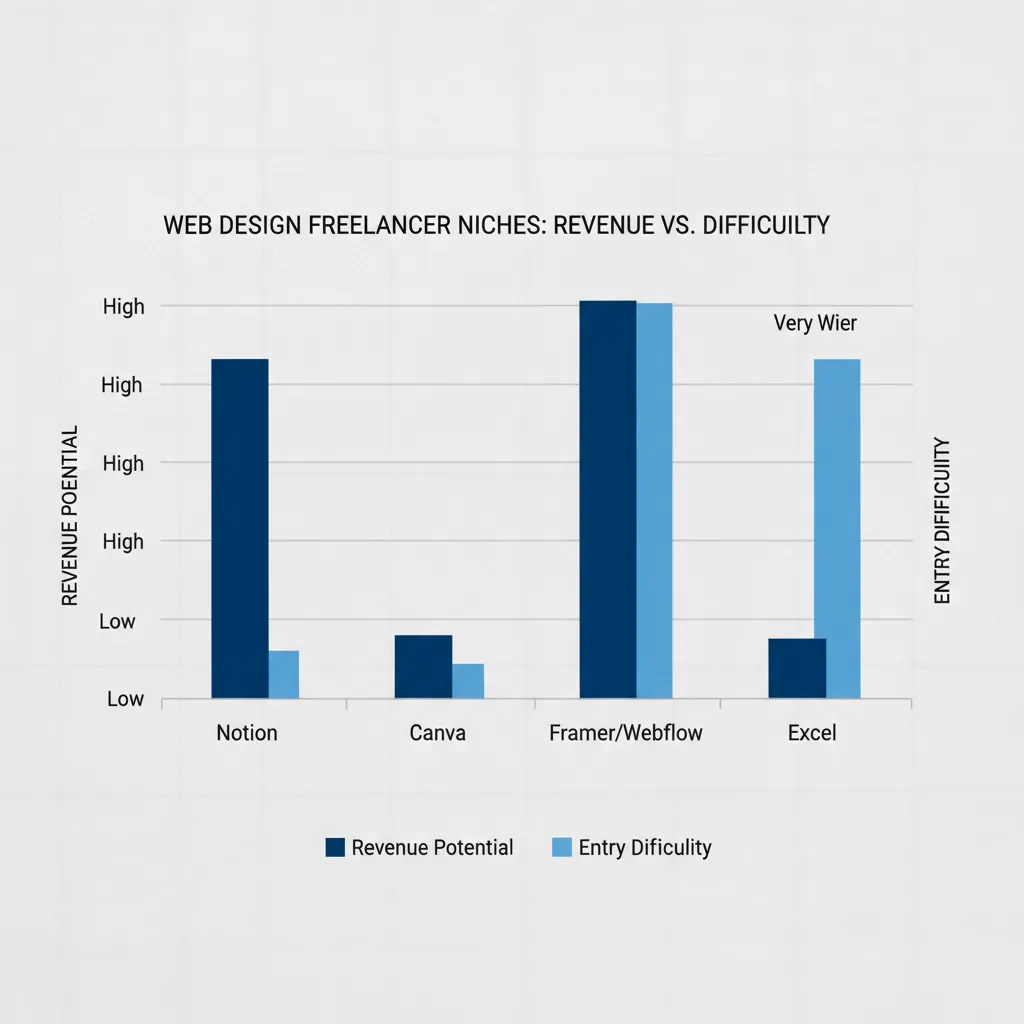
1. The Productivity Giant: Notion Ecosystem
Notion has transcended being just an app; it is an economy. According to a June 2024 Nasdaq interview, productivity expert Thomas Frank revealed he made over $100,000/month selling Notion templates. The key here is specificity. Generic “Life Planners” are saturated. The money is in “Content Operating Systems for YouTubers” or “Student Thesis Managers.”
Case in point: Easlo, a student who scaled to over $500,000 in total sales. He didn’t create complex code; he created minimalist, functional dashboards. (Source: Kajabi Case Studies, 2024).
2. The Design Standard: Canva & Social Kits
This is the volume play. According to income reports from The Side Blogger, successful Canva sellers consistently generate $1,000 – $3,000/month using a hybrid model of Etsy (for traffic) and their own website (for margins). The best B2B angle here is selling “Client Onboarding Kits” or “Instagram Carousel Templates” specifically for social media managers who need to churn out content quickly.
3. The No-Code Wave: Framer & Webflow
This is where high-ticket digital products live. Unlike a $10 Canva template, a high-quality Framer website template can sell for $49 to $129. Wize Design, a prominent agency in this space, reported $30,000/month selling website templates in their 2025 projections, noting that Framer templates are “as passive as it gets for web designers” compared to client services.
4. The Boring but Profitable: Excel & Google Sheets
Never underestimate the business world’s reliance on spreadsheets. Templates for “Inventory Management,” “Small Business Bookkeeping,” or “Construction Estimating” sell exceptionally well on Etsy because they solve an immediate, painful financial problem for the buyer.
Legal & Copyright: The “Canva Pro” Trap & Licensing
This is the section most “passive income gurus” skip, and it is where you can get sued or banned. If you take away one thing from this guide, let it be this: You cannot sell what you do not own.
⚠️ The Canva “Flattened PDF” Rule
Many freelancers think they can design a template using Canva Pro elements and sell it. This is a violation of Canva’s Terms of Service. You generally cannot sell a template that contains standalone Pro elements if the end-user (your customer) needs a Pro account to use them. For editable templates, you should stick to Free elements or ensure your buyer understands they must license the Pro elements themselves.
Understanding Commercial Use vs. PLR
When you sell a template, you are usually granting a Commercial License (the buyer can use it for their business) or a Personal License (they can use it for themselves).
Avoid PLR (Private Label Rights) unless that is your specific business model. PLR allows the buyer to resell your template as their own. As a freelancer building a brand, you want to retain the intellectual property (IP) and only license the usage rights.
Protecting Your IP
How do you stop theft? You can’t 100% prevent it, but you can mitigate it.
- Terms of Service: Include a strict “No Resale” clause in your checkout.
- Watermarks: Essential for previews on Etsy or Pinterest.
- The “No Refund” Policy: Digital products are irrevocable. Your policy must state “Due to the digital nature of this product, all sales are final.”
Platform Showdown: Where to Host Your Empire
Choosing a platform is a trade-off between Traffic and Control. According to a September 2024 report by Sacra, Gumroad sellers earned over $21M in revenue, stabilizing creator income despite a fee hike, proving that creators value the platform’s infrastructure.
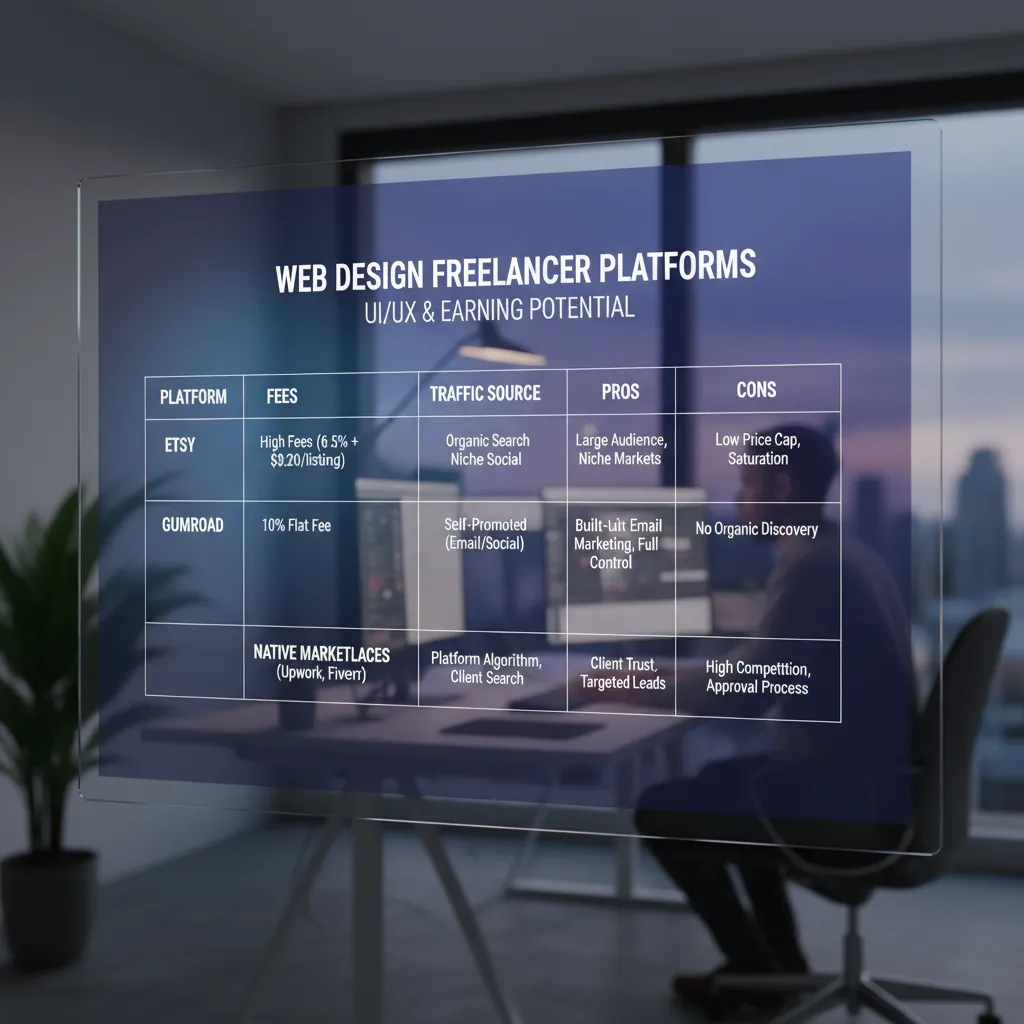
Etsy
- Best for: Canva templates, Excel sheets, Planners.
- The Reality: High traffic but a “bargain hunter” mentality. It’s hard to sell a $100 item here.
Gumroad / LemonSqueezy
- Best for: Notion templates, coding snippets, educational guides.
- The Reality: You own the customer email list (unlike Etsy). However, you must drive your own traffic via LinkedIn, Twitter, or YouTube.
Native Marketplaces (Framer/Webflow/Notion)
- Best for: High-ticket software templates.
- The Reality: High barrier to entry. Erfan, a UI/UX designer, noted in a community case study that he hit his first $1,000 in sales within 3 days on the Framer marketplace because the demand for quality design outpaced supply.
The Hidden Reality: Support, Updates, and “Passive” Myths
Is selling templates truly passive? No. It is leveraged, not passive. If you treat it as “set and forget,” your reviews will tank.
The “Broken Link” Burden
The most common customer support email isn’t about the design; it’s tech support. “I can’t unzip the file” or “The link doesn’t work.” To automate this, successful sellers use auto-responders or a “Start Here” PDF included in the download that troubleshoots these basic issues.
The Update Cycle
What happens when Notion updates their API or Canva changes their interface? Your templates break. You must schedule a “Product Audit” day once a quarter to verify your assets still work. If you ignore this, you are selling broken tools.
Step-by-Step Launch Strategy for Freelancers
Don’t overthink the product. The best digital product is the one you already built for a client (scrubbed of sensitive data, of course).
1. The Internal Tool Test
Look at your “Sent” folder. What document have you sent to clients five times this month? A briefing document? A content calendar? A contract template? That is your product. According to The Leap’s 2024 Creator Economy Report, digital products are the #1 income stream for full-time creators, with 67% of monetized creators selling them. Join them by productizing your existing workflow.
2. Pricing for Value vs. Volume
Do you sell 100 items at $19, or 10 items at $199?
- $19 – $29: Impulse buys. Good for Etsy/Pinterest traffic. (e.g., Social Media Kits).
- $99 – $199: Investment buys. Requires a sales page and video walkthrough. (e.g., Complete Agency Operating Systems).
💰 Service vs. Scale Calculator
Calculate how many template sales it takes to beat your freelance hourly work.
FAQ: Navigating the Template Economy
Do I need a business license to sell digital templates?
Generally, yes. Even as a sole proprietor, selling goods (even digital ones) usually requires a basic business license in your city or county. Furthermore, platforms like Gumroad act as a “Merchant of Record,” handling VAT and sales tax for you, which simplifies the process immensely.
Does selling templates hurt my freelance service rates?
Surprisingly, no. In my experience, it acts as a “down-sell.” If a client can’t afford your $5,000 web design package, they might buy your $100 template. It keeps them in your ecosystem until they can afford you.
How to sell Canva templates legally in 2025?
Stick to using Free elements in your design if you want the widest compatibility. If you use Pro elements, clearly label your product as “Canva Pro Required.” Never download the assets and sell them as individual PNGs; you must share the “Template Link.”
What is the most profitable digital product to sell?
While notions templates are popular, B2B templates (Business to Business) generally command higher prices. Systems that help other business owners make money (e.g., “Sales CRM Template” or “Agency Client Portal”) have the highest perceived value.
Conclusion
Can selling templates boost your freelance income? The data from 2024 and 2025 says yes, but only if you treat it as a serious business arm, not a lottery ticket. The freelancers winning in this space are the ones who view templates as scalable intellectual property.
By productizing your knowledge, you decouple your income from your time. You create an asset that works while you sleep, creating the financial stability needed to say “no” to bad clients and “yes” to projects that light you up.
Your Next Step: Don’t try to build a massive library. Start by productizing one internal process this weekend. Clean up that spreadsheet, design that Notion dashboard, or package that social media layout. Put it on Gumroad. Price it at $29. Send it to your network. That is how you start the engine.