What is the core difference: UI vs UX design? (2025 Guide)
Imagine you are designing a luxury car. UX (User Experience) is the engine performance, the suspension that glides over bumps, and how perfectly the seat molds to your back. It’s the feeling of safety and reliability. UI (User Interface) is the dashboard layout, the stitching on the leather, and the sleek curve of the chassis. One makes the car driveable; the other makes you want to buy it.
I’ve worked in the digital product space for years, and the confusion between these two terms never fades. Are they the same person? Do you need to code? Which one pays more? In 2025, these aren’t just academic questions—they are financial ones. With the rise of AI tools like Midjourney and ChatGPT, the roles are converging, yet their core distinctions remain sharper than ever.
This isn’t just another definition guide. We are going to dive deep into the 2025 market intelligence, dissect real salary data from Robert Half, and analyze the ROI statistics that business leaders actually care about. Whether you are a student planning your career or a business owner wondering why your app is failing, this is the definitive breakdown you’ve been looking for.

The Core Difference: Form (UI) vs. Function (UX)
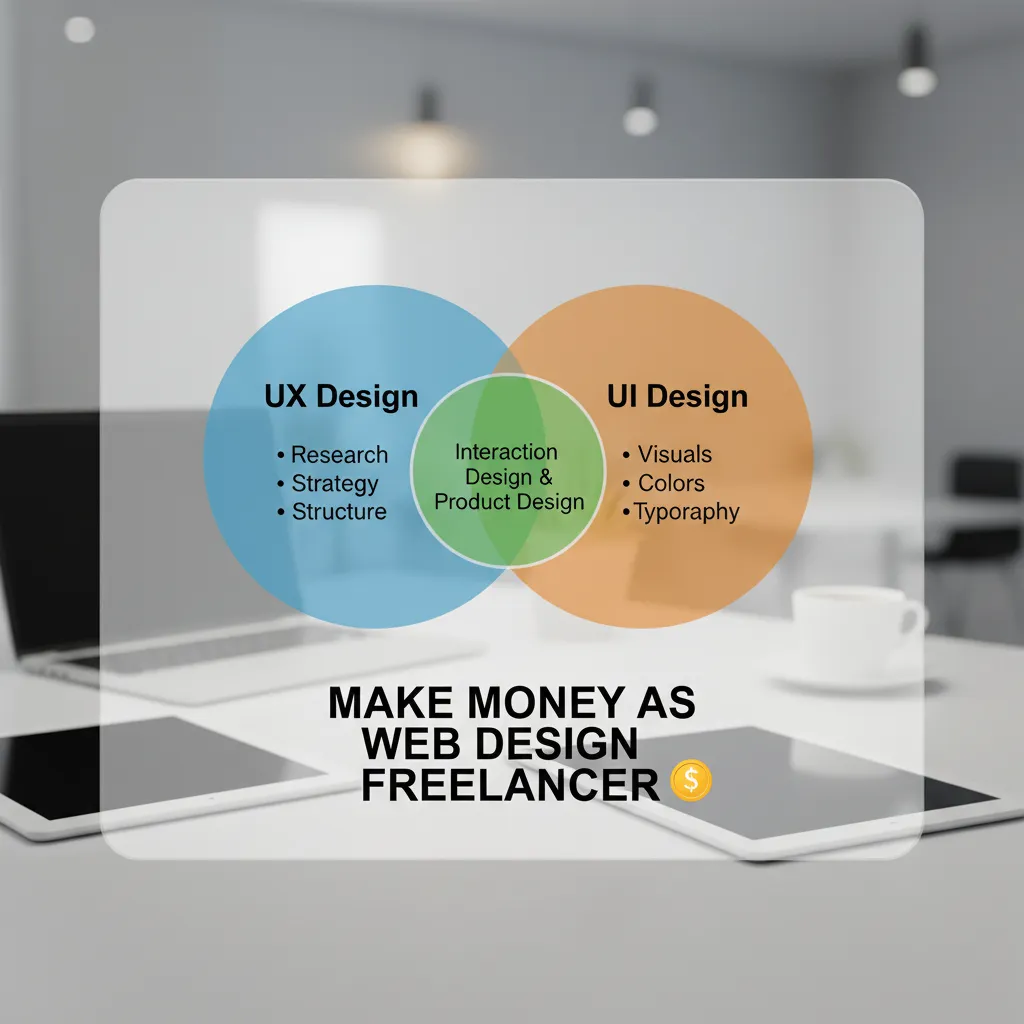
At its simplest level, UX Design is about how it works, and UI Design is about how it looks. But to leave it there would be a disservice to the profession. These two disciplines are the left and right brain of product development.
What is User Experience (UX) Design? (The Scientific Side)
UX design is human-centric science. It is not about art; it is about problem-solving. A UX designer is concerned with the entire journey a user takes to solve a problem. This involves heavy research, psychology, and structural planning before a single pixel is colored.
According to The Interaction Design Foundation (2025), UX encompasses all aspects of the end-user’s interaction with the company, its services, and its products. It is the “why” and the “how.”
A UX designer’s day is filled with:
- User Research: Conducting interviews to understand pain points.
- Information Architecture (IA): Structuring how content is organized (the blueprint).
- Wireframing: Creating low-fidelity skeletal frameworks.
- Usability Testing: Watching people struggle with the product to fix it.
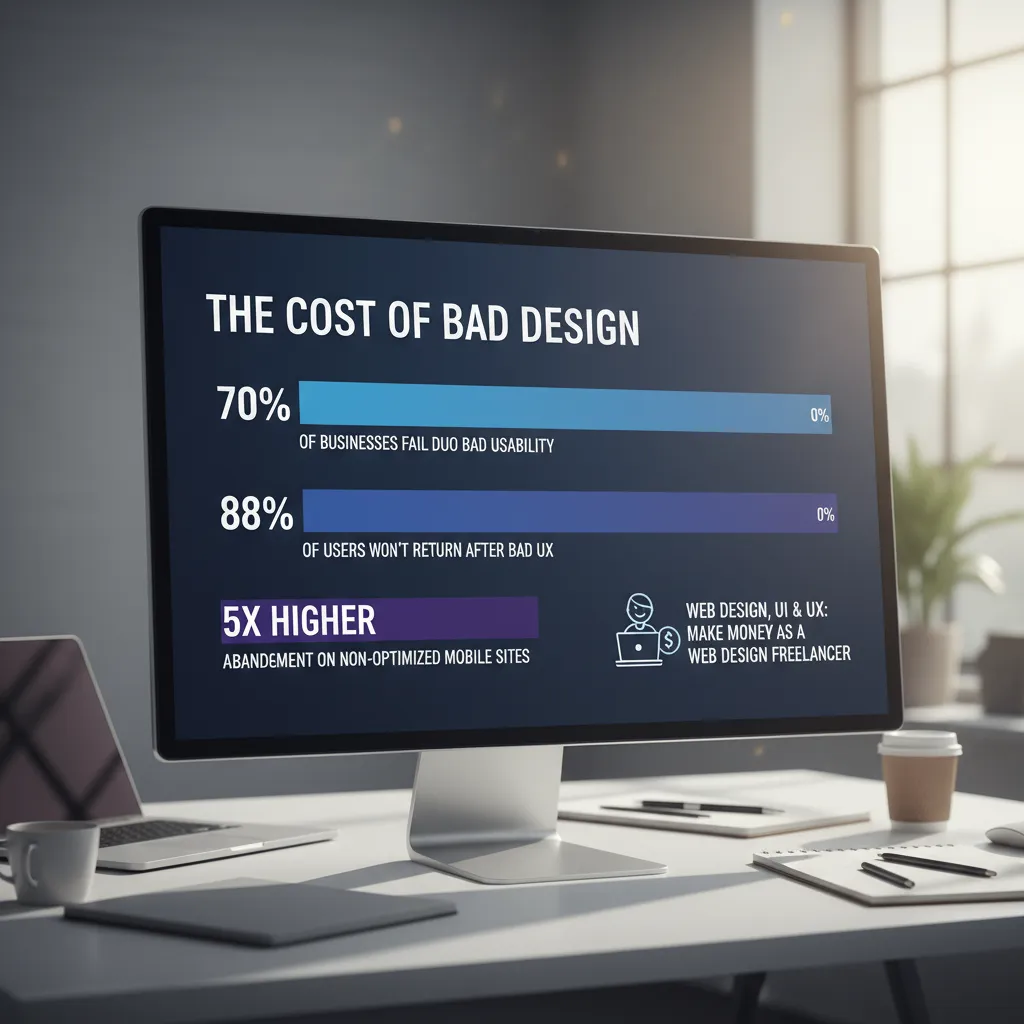
There is a massive financial incentive here. According to UserGuiding’s 2025 report, 70% of online businesses fail due to bad usability. If the UX is broken, the business model is broken.
What is User Interface (UI) Design? (The Artistic Side)
If UX is the blueprint, UI is the interior design. It is the process of transforming wireframes into a high-fidelity, polished product that users can interact with. However, unlike pure art, UI design is objective. It relies on visual hierarchy to guide the user’s eye.
UI designers focus on:
- Typography & Color Theory: Ensuring readability and brand consistency.
- Interactivity: Designing buttons, toggles, and drop-downs.
- Responsive Design: Ensuring the layout adapts from desktop to mobile.
- Accessibility (WCAG): Making sure colors have enough contrast for visually impaired users.
The stakes for UI are incredibly high. According to a 2025 report by UXCam, 94% of first impressions are design-related. You can have the best backend code in the world, but if the interface looks dated or untrustworthy, users will bounce immediately.
2025 Market Intelligence: Salaries & Job Demand
Let’s talk money. This is usually the deciding factor for career switchers. In the past, UX often commanded a higher premium due to its strategic nature, but as “Product Design” (a hybrid role) becomes the norm, the lines are blurring.
UI vs UX Designer Salary Breakdown
Based on verified data from the Robert Half 2026 Salary Guide (accessed 2025), here is what the financial landscape looks like in the US market:
| Role | Experience Level | Average Annual Salary (US) |
|---|---|---|
| UI Designer | Entry-Level | $80,000 – $95,000 |
| UX Designer | Entry-Level | $85,000 – $102,000 |
| Senior UX Researcher | Senior (5+ Years) | Up to $142,250 |
| Product Designer | Mid-Senior | $110,000 – $160,000 |
You’ll notice that UX roles tend to have a slightly higher ceiling. This is because UX is tied directly to business metrics and ROI, whereas UI is often viewed (incorrectly) as execution-only. However, the highest earners today are “Product Designers” who possess skills in both camps.
Job Growth Projections
Is the field saturated? Far from it. According to the U.S. Bureau of Labor Statistics, employment for digital designers is projected to grow 16% from 2022 to 2032, which is much faster than the average for all occupations.
The Financial Impact: Why Business Leaders Care
If you are a business owner reading this, you might think design is a “nice to have.” The data proves otherwise. Design is not an expense; it is an investment with a calculated return.
Forrester Research indicates that every $1 invested in UX results in a return of $100.
Source: Maze / Forrester Research (2024)
Conversely, the cost of ignoring UX is catastrophic. Bad design literally bleeds money. A report cited by JoBins Engineering (2024) utilizing Deloitte data highlights that slow-loading sites and poor usability cost store owners $2.6 billion in lost revenue annually.
Consider mobile users. We live in a mobile-first world. According to The Brand Shop’s 2024 statistics, mobile users are 5 times more likely to abandon a task if the website isn’t optimized for mobile. That is a direct loss of potential customers due to poor UI/UX integration.
The AI Revolution: Will Robots Replace Designers?
This is the question I hear most often in 2025. “Why should I learn UI design if Midjourney can generate a website layout in seconds?”
Here is the reality: AI isn’t replacing designers; it is replacing junior tasks. According to UXtweak’s 2025 statistics, 95.3% of UX researchers are already using or considering AI in their workflows.
How AI Splits the UI vs UX Field
- AI in UX: Tools like ChatGPT and Synthetic Users are being used to generate user personas and analyze vast amounts of qualitative data instantly. It accelerates the “Double Diamond” process but cannot replace the empathy required to understand human emotion.
- AI in UI: Generative UI tools (like Galileo AI or Uizard) can build high-fidelity screens from text prompts. This raises the bar. “Pixel pushing” is dead. The modern UI designer must now be an editor and a curator, understanding why a layout works rather than just how to build it in Figma.
AI cannot replicate the human nuance required to solve complex problems. Maze’s 2025 report notes that 70% of Gen Z users want websites to “intuitively know what they want.” Predicting intent requires a human architect (UX) and a seamless interface (UI) working in harmony.
Real-World Case Studies
To truly understand the difference, let’s look at two tech giants.
Spotify: The Psychology of “Discover Weekly”
Spotify’s success isn’t just because it has a lot of music. It’s the UX of personalization. The “Discover Weekly” algorithm is a UX feature designed to increase retention. The UI is the dark mode aesthetic, the vibrant green play buttons, and the swipe gestures that make the app feel cool and immersive. The UX keeps you paying; the UI keeps you tapping.
Airbnb: Trust Through Design
Airbnb’s core problem was trust. How do you get strangers to sleep in each other’s homes?
The UX Solution: A robust review system and a secure payment gateway.
The UI Solution: High-quality photography, clean typography, and a friendly, warm color palette that evokes “home” rather than “hotel.”
According to WebAlive (2024), judgments on website credibility are 75% based on overall aesthetics. Airbnb’s UI literally bought them the credibility to disrupt the hotel industry.
FAQ: Common Career Questions
Do I need to code to be a UI or UX designer?
Generally, no. However, understanding the basics of HTML and CSS is a massive advantage. It helps you understand the technical limitations of your designs. This facilitates a smoother handoff to developers, which is a critical soft skill.
What comes first: UI or UX?
UX almost always comes first. You cannot design the interior of a house (UI) before you have the architectural blueprints (UX). However, in agile environments, these processes often happen in parallel.
Can one person do both?
Yes, and they are often called “Product Designers” or “Full-Stack Designers.” While these roles are highly paid, they can be exhausting. In my experience, most designers naturally lean towards either the analytical side (UX) or the visual side (UI).
Conclusion: The Convergence in the AI Era
So, what is the core difference between UI and UX design? UX is the science of usability; UI is the art of interaction. But in 2025, treating them as silos is a mistake.
With the global UX design market projected to reach USD 22.62 billion by 2030 (Mordor Intelligence, 2025), the opportunity is massive for those who understand the full picture. Whether you are optimizing for the $100 ROI or ensuring your site complies with the new accessibility laws, the marriage of form and function is where the future lies.
If you are looking to enter this field, don’t just learn Figma. Learn people. Learn psychology. And remember: great design is invisible. It just works.