How to Build a High-Value Freelance Web Design Brand in 2025 (The Ultimate Guide)
Move from being a commodity to a consultant. Here is the blueprint for commanding $10k+ projects.
In 2025, your technical skills get you the meeting, but your brand dictates the price. It’s a harsh reality I’ve seen play out hundreds of times: two designers with identical skill sets charge vastly different rates. One struggles to get $50 an hour; the other bills $10,000 per project without blinking.
The difference isn’t the code. It’s the perception of value.
According to Clutch, judgments on a website’s credibility are 75% based on its overall look. If you are selling design services, you are the primary case study. If your personal brand looks like a discount bin, clients will treat you like a discount vendor.
You might be thinking, “I’m just a freelancer, not an agency. Do I really need a ‘brand’?”
Here is the thing: In an economy where freelancers contributed $1.27 trillion to the U.S. economy recently—according to the Upwork Research Institute—the market is crowded. You cannot afford to be invisible.
This guide isn’t about picking a pretty color palette. It is about the business strategy of branding—how to position yourself to attract high-ticket clients who value your expertise over your hourly rate.
The Economics of Branding: Why Portfolio ≠ Brand
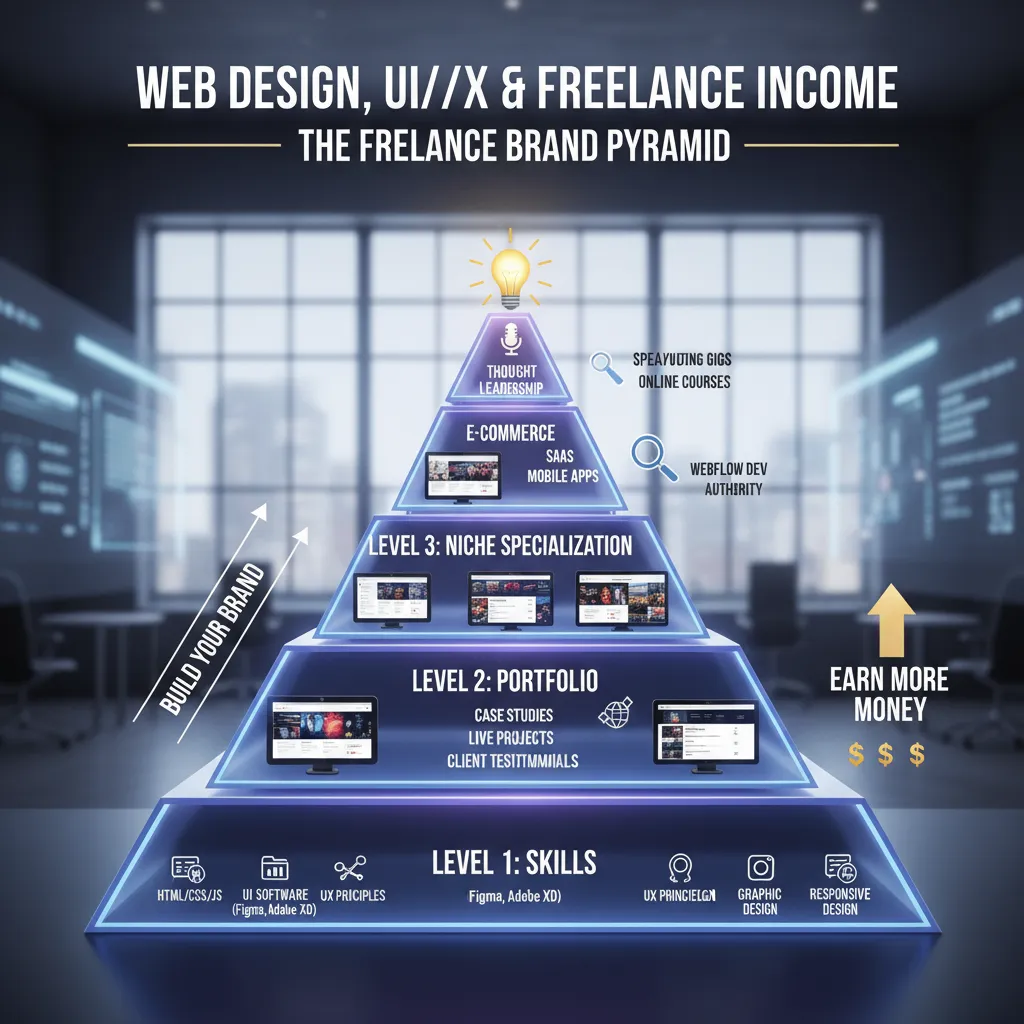
Many designers confuse a portfolio with a brand. A portfolio is a repository of past work; a brand is a promise of future results.
When I first started, I thought my work spoke for itself. I was wrong. Clients aren’t just buying a website; they are buying risk reduction. They want to know that handing you their money isn’t a gamble.
The Trust Gap
Data from Clutch reveals that 84% of consumers say design influences whether they shop with a brand. When a potential client lands on your portfolio, they are subconsciously asking: “Does this person understand modern business, or do they just know how to use Figma?”
If your branding is inconsistent, you create a “trust gap.” High-value clients bridge that gap by hiring expensive agencies. Your job is to look just as safe as an agency, but with the agility of a freelancer.
Commodity vs. Luxury
There is a massive shift happening. According to FreshBooks, web designers typically charge about $75 per hour. That is the “commodity” rate. It pays the bills, but it doesn’t build wealth.
To break the $100/hr or $10k/project ceiling, you must shift your brand narrative from “I build websites” (commodity) to “I solve business problems through design” (consultant).
Step 1: Defining Your “Blue Ocean” Niche
The biggest mistake I see early-stage freelancers make is fear of narrowing down. They want to work with “everyone.” But when you speak to everyone, you speak to no one.
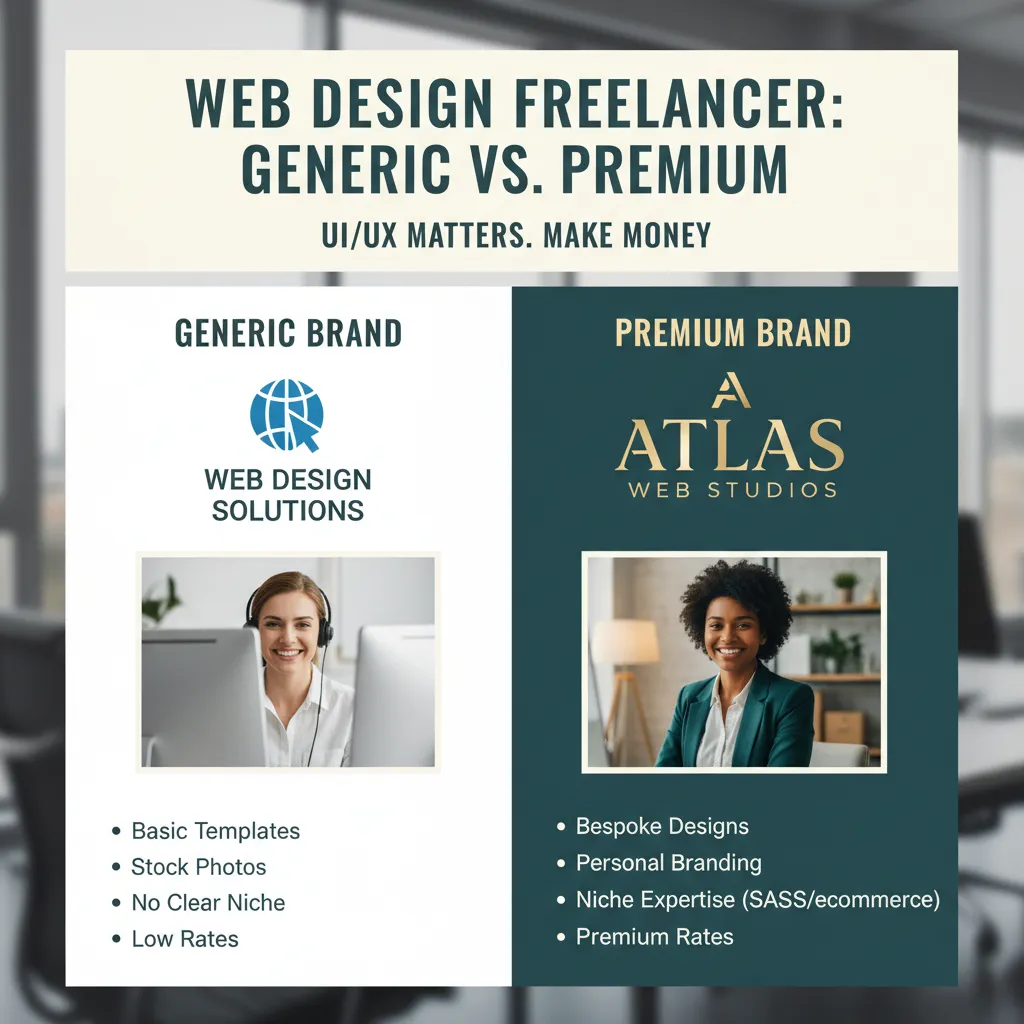
The “Generalist’s Trap” vs. The “Specialist’s Premium”
Imagine a client runs a FinTech startup. They have two options:
- A “Web Designer” who has done a bakery site, a gym site, and a blog.
- A “SaaS Interface Specialist” who understands churn rates and user onboarding.
The specialist charges double. The client pays it gladly because the specialist understands their specific pain points.
According to Grand View Research, the global freelance platform market is valued at over $1.2 billion. The slice you need to be profitable is tiny. You don’t need the whole market; you need a specific, high-paying corner of it.
2025 Profitable Niches
Based on current market trajectories, here are the high-value sectors for 2025:
- AI Startups: These companies are flush with VC cash but often lack visual identity.
- Eco-commerce: Sustainable brands need earthy, trust-building design.
- FinTech: High regulation means they need serious, secure-looking design.
Step 2: Visual Identity & The “Shoemaker’s Shoes” Paradox
You know the old saying, “The shoemaker’s children go barefoot”? Most web designers have terrible personal websites. They are too busy working on client projects to update their own.
This is a fatal error. In 2025, your website is your best salesperson.
The Mobile-First Credibility Test
It sounds basic, but Clutch reports that over 60% of web traffic comes from mobile devices. I cannot tell you how many designer portfolios break on mobile. If your personal site isn’t flawless on a phone, you are telling the client, “I can’t handle the majority of your traffic.”
Visual Trends to Adopt (And Avoid)
Your brand needs to look current but timeless. According to a recent Creative Trends Report by Adobe, a dominant trend is “Calming Rhythms.” This involves fluid shapes and soothing aesthetics that counter the chaos of the digital world.
Brenda Milis, Principal of Consumer and Creative Insights at Adobe, notes that consumers are “craving visuals that inspire and reflect the endless possibilities of the imagination.”
Actionable Tip: Don’t just follow the trend—anchor it. If you choose a “Calming Rhythm” aesthetic, pair it with bold, accessible typography (WCAG compliance is a huge selling point in 2025).
Step 3: Curating a Conversion-Focused Portfolio
Stop uploading every logo you’ve ever made. The “3-Project Rule” suggests that clients only look at your top three projects before making a judgment call.
Case Studies: Problem → Process → Result
A pretty picture is not a case study. A case study is a business story.
Instead of just showing the final homepage, structure your projects like this:
- The Challenge: “Client X had a bounce rate of 70%.”
- The Strategy: “We reorganized the information architecture and streamlined the checkout flow.”
- The Result: “Bounce rate dropped to 40%, increasing revenue by $15k/month.”
Data sells. If you can’t get hard numbers, get a testimonial that speaks to the feeling of the result.
Step 4: Content Marketing & Authority Building
You might hate social media, but “Building in Public” is the fastest way to accelerate trust.
The LinkedIn Pivot
LinkedIn has transformed from a resume site to a creator platform. With 48% of CEOs planning to boost freelance hiring—according to Upwork’s Future Work Index—your content needs to be where the CEOs are.
Don’t post “I’m open for work.” Post: “Here is how I fixed a navigation error that was costing a client sales.” Shift from asking for work to demonstrating value.
Leveraging AI Without Losing Your Soul
There is a fear that AI is killing web design. The reality is that AI is a force multiplier for branding. A survey by Clutch found that 93% of web designers report using AI tools in their process. 58% use it to generate original imagery.
My advice: Use AI to handle the “boring” parts of branding—generating copy variations for your landing page, resizing assets, or brainstorming mood boards. This frees you up to do the high-level strategy that clients actually pay for.
Step 5: The Client Experience as a Brand Pillar
Your brand isn’t just what they see; it’s how they feel when they work with you. The “Client Experience” (CX) is often the deciding factor for referrals.
If you have a sleek website but send invoices via a messy email thread, you break the brand illusion. Premium freelancers use branded onboarding documents, clear contracts, and professional invoicing tools.
Value-Based Pricing Calculator
Stop charging by the hour. It penalizes you for being fast. Use this simple calculator concept to determine if you are charging based on value.
Hourly vs. Value Estimator
See the difference in earning potential on a standard 40-hour project.
Note: The calculation above assumes a standard “10% of value” pricing model. If your website helps a client make $50,000, charging $5,000 is a no-brainer for them, whereas $3,000 based on hours feels like a cost.
FAQ: Building Your Freelance Brand
Yes, but keep it simple. You don’t need an abstract symbol. In 2025, a clean, well-typeset wordmark (your name or studio name) is often seen as more premium and confident than a complex icon.
Monetarily, it’s low—domain and hosting cost under $100/year. The real cost is “sweat equity.” Expect to spend 40-60 hours building your initial brand strategy, copy, and portfolio site.
Absolutely. If you lack client work, build “Concept Projects.” Redesign a local non-profit’s site or create a UI for a hypothetical app. Treat these exactly like real client projects in your case studies. As Margaret Lilani from Upwork notes, freelancers are seeking autonomy and earning power—you have to start by demonstrating capability, even on hypothetical work.
The low end is saturated. The strategic end is starving for talent. With 53% of Gen Z freelancers working full-time hours according to Upwork, the competition is fierce, but most are competing on price. Brand yourself on value, and you leave the saturation behind.
Conclusion: Your 30-Day Launch Roadmap
Building a brand feels overwhelming, but it is just a series of small decisions. Here is your roadmap to relaunching yourself as a premium consultant:
- Week 1: Define your niche. Who do you serve? (e.g., “Webflow for Green Tech”).
- Week 2: Build your visual identity. Choose accessible typography and a color palette that reflects the psychology of your niche.
- Week 3: Curate 3 deep case studies. Focus on the business results, not just the pixels.
- Week 4: Launch your “Home Base” (portfolio site) and optimize your LinkedIn profile to match.
The market is waiting. The data shows companies are hiring. The only variable left is whether you present yourself as a risky expense or a high-value investment.