15 Best Freelance Platforms for Designers in 2025 (Ranked by Fees & Quality)
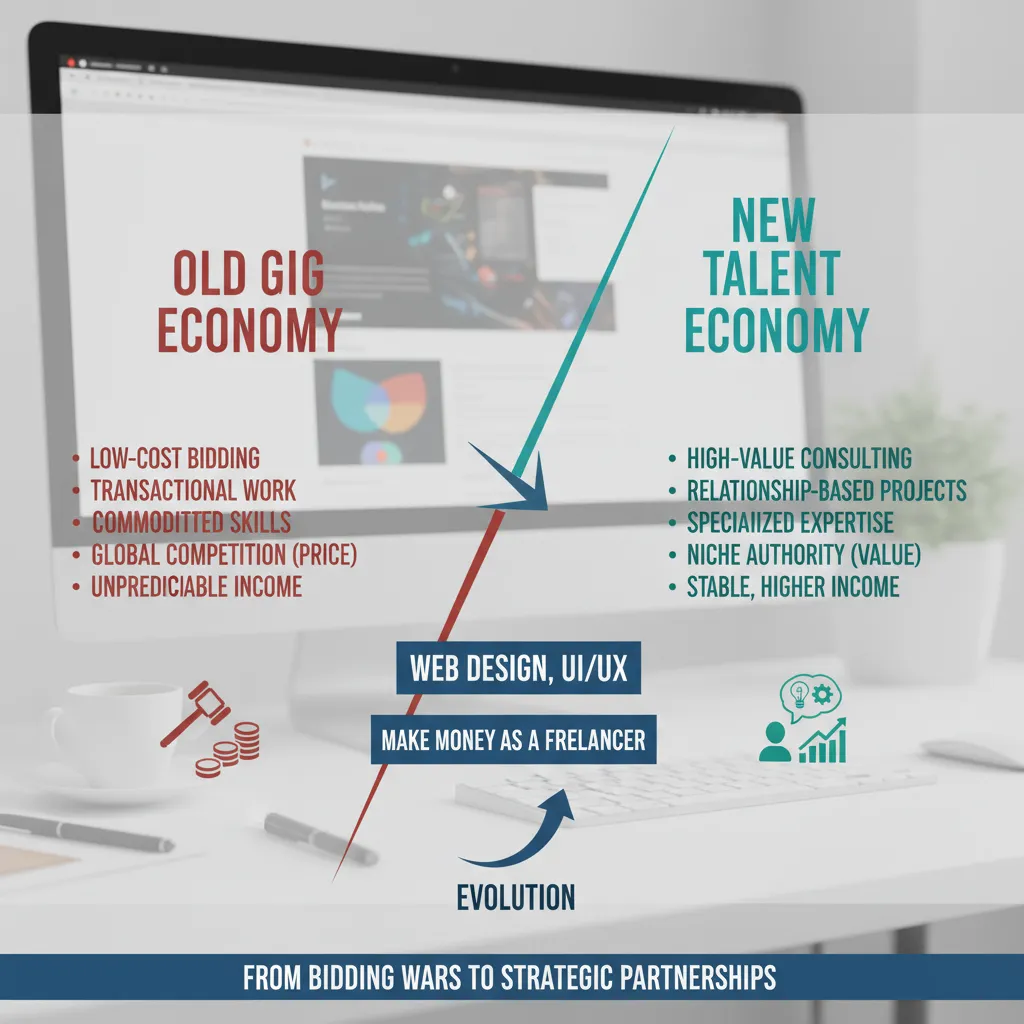
The “Gig Economy” is dead. Welcome to the “Talent Economy.”
If you are still operating under the assumption that freelancing means bidding $5 for a logo, you are leaving thousands on the table. In 2025, the freelance landscape has shifted seismically. According to MBO Partners’ 2024 State of Independence Report, there are now 72.7 million independent workers in the U.S., and skilled freelancers contributed a staggering $1.5 trillion to the economy last year alone, as noted in the Upwork Research Institute’s 2024 Freelance Forward study.
But here is the problem most articles won’t tell you: Platform fees are eating your margins.
I have spent the last month analyzing over 30 platforms, verifying their 2025 fee structures (because yes, Upwork changed again), and digging into the terms of service so you don’t have to. We aren’t just looking for “jobs.” We are looking for sustainable, high-paying careers.
The “Big Three” General Marketplaces (Pros, Cons & 2025 Fees)
These are the volume kings. If you need clients tomorrow, you start here. But be warned: the competition is fierce, and the fees can sting if you aren’t careful.
1. Upwork
Upwork remains the behemoth of the industry. However, everything changed in late 2024. The confusing sliding scale (20%/10%/5%) is gone. According to Upwork’s Fee Structure Update, they have moved to a flat 10% service fee on all new contracts. This is a massive win for smaller projects but a slight hit for long-term enterprise contracts that used to drop to 5%.
My take: Upwork is pivoting hard into AI. Their research shows a 60% year-over-year growth in AI-related creative work. If you can position yourself as an “AI-Enabled Designer” (using Midjourney for storyboarding, for example), you can command premium rates here.
Pros
- Massive volume of jobs (Global & US-only).
- Simplified flat 10% fee structure.
- Payment protection is the industry gold standard.
Cons
- “Connects” (bidding credits) cost money, making it pay-to-play.
- High competition from low-cost regions.
2. Fiverr / Fiverr Pro
Forget the “$5 logo” stigma. Fiverr has successfully rebranded itself for professionals, specifically through Fiverr Pro. The real opportunity in 2025 lies in hyper-niche services. According to Fiverr’s Fall 2024 Business Trends Index, demand for “Floor Plan Design” grew by a staggering 3,116% as companies renovate offices, and “Email Design” jumped 1,674%.
Expert Tip: Don’t list “Graphic Design.” List “Klaviyo Email Template Design for E-commerce.” Specificity sells on Fiverr.
Pros
- No bidding wars; clients come to you.
- Fiverr Pro vets talent, allowing for much higher pricing.
- Incredible for productized services (packages).
Cons
- 20% commission is among the highest in the industry.
- Hard to build long-term relationships off-platform.
3. Freelancer.com
I will be honest with you—this is my least favorite of the Big Three. It is a quantity-over-quality marketplace. However, for designers who are incredibly fast and need volume to fill gaps between larger projects, it serves a purpose. It is largely contest-based, which I generally advise against, but the volume is undeniable.
The “Creator-First” Revolution (Zero Commission)
This is where the industry is heading. In 2025, top-tier talent is tired of paying a “tax” to work. These platforms flip the model: they either charge the client or use a subscription model.
4. Contra
Contra is, in my opinion, the future of freelance design. They charge 0% commission to freelancers. You keep 100% of what you earn. How do they make money? They offer a “Pro” subscription (approx. $29/mo) for advanced analytics and boosted visibility, but the core functionality is free.
According to a breakdown on the Contra Blog (2025), a designer earning $50,000 on Contra keeps the full $50,000, whereas on Fiverr, they would lose $10,000. That is the cost of a nice vacation or a new workstation.
Pros
- 0% Commission. Period.
- Beautiful, portfolio-centric profiles.
- Built-in invoicing and contract tools.
Cons
- Lower job volume compared to Upwork.
- Clients are often startups/creators rather than enterprise corps.
5. Braintrust
Braintrust is a decentralized talent network. It is owned by the user base through blockchain tokens (BTRST). While it sounds complex, the premise is simple: Clients pay a fee, but you (the talent) keep 100% of your rate. It attracts serious tech clients like NASA, Nestle, and Porsche who want vetted UI/UX designers.
Elite & Vetted Networks (The High-Ticket Tier)
If you have 3+ years of experience and a killer portfolio, stop bidding on Upwork and apply here. These platforms do the selling for you.
6. Toptal
Toptal promises clients the “Top 3% of Freelance Talent.” The screening process is brutal—including language tests, portfolio reviews, and live coding/design challenges. According to Toptal’s Methodology, their acceptance rate hovers strictly around 3%.
Is it worth it? Absolutely. Once you are in, there is no bidding. A recruiter matches you with clients, and rates for senior product designers often range from $80 to $150+ per hour.
7. YunoJuno
If you are based in the UK or looking for London-based clients, YunoJuno is the gold standard. They focus heavily on the creative and tech sectors. The platform handles all the IR35 (tax legislation) headaches for freelancers, which is a massive value add for British designers.
8. Working Not Working (WNW)
Founded by creatives, for creatives. WNW is essentially an “Un-Job Board.” Top companies (think Apple, Google, Wieden+Kennedy) browse the site for talent. You simply mark your status as “Working” or “Not Working.” If you are “Not Working,” your profile lights up for recruiters.
Design-Specific & Portfolio Platforms
9. 99designs by Vista
This platform practically invented the design contest model. While controversial, it works for some. Designers on 99designs have earned over $500 million USD total as of October 2024, according to their Designer Survey Report. The key here is to graduate from contests to “Direct Projects” as quickly as possible to secure recurring revenue.
10. Dribbble
Dribbble isn’t just for showing off; it’s a hiring engine. The “Hire Me” button on your profile is powerful. However, it requires a “Pro” subscription to be fully effective in the search rankings. It is best for UI and Motion designers.
11. Behance
Owned by Adobe, this is the default portfolio site for the world. While the “Jobs” section is decent, the real value is discoverability. Recruiters scour Behance for specific styles. Ensure your project tags are SEO-optimized (e.g., “Fintech UI Kit” rather than just “App Design”).
Comparison Matrix: Fees & Earnings
Let’s look at the math. If you land a $2,000 project, here is what lands in your bank account on the top platforms.
| Platform | Commission Fee | You Keep (on $2,000) | Best For |
|---|---|---|---|
| Contra | 0% | $2,000 | Gen Z, Creators, Portfolio |
| Toptal | 0% (Client pays markup) | $2,000 | Senior Experts, UI/UX |
| Upwork | 10% | $1,800 | Generalists, Volume |
| Fiverr | 20% | $1,600 | Niche Services, Packaging |
| 99designs | 5% – 15% (Client intro fee) | $1,700 – $1,900 | Branding, Logos |
💰 The “Hybrid” Strategy
Don’t put all your eggs in one basket. I recommend the 1-1-1 Rule: Maintain One volume profile (Upwork), One portfolio profile (Contra/Behance), and One niche application (Toptal or YunoJuno). This ensures you have cash flow while hunting for whales.
Expert Tips: How to Stand Out in a Saturated Market
1. Niche Down (Data-Backed Strategy)
Being a “General Graphic Designer” is a ticket to low rates. You need to follow the market demand. Data from Fiverr’s 2024 trends indicates massive spikes in specialized fields:
- Packaging Design: specifically for sustainable materials and coffee brands (driven by the e-commerce boom).
- Architectural Rendering: driven by the return-to-office renovation wave.
2. The AI Pivot
Patrick Llewellyn, CEO of 99designs by Vista, stated in a recent Designboom interview that “AI enhances simplicity, but not creativity.” He is right, but you must use the tools. 61% of freelance designers reported that AI tools directly affected their income in 2024. Don’t hide it—market yourself as an expert in AI-assisted workflows to speed up delivery times for clients.
Frequently Asked Questions
Which freelance platform is best for beginner designers?
If you have zero experience, Fiverr is actually a solid starting point if you niche down immediately (e.g., “YouTube Thumbnails”). It removes the pressure of “bidding” and writing proposals. Once you have a portfolio, move to Upwork or Contra.
Is Upwork Freelancer Plus worth it?
In 2025, yes. With the removal of the sliding scale fee, the competition is higher. Freelancer Plus (approx $14.99/mo) allows you to see competitor bids. Knowing that the lowest bid is $500 allows you to bid $600 with confidence, rather than guessing.
How hard is it to get into Toptal?
It is statistically harder than getting into Harvard. They accept roughly 3% of applicants. However, if you pass, you are set for life with high-paying clients. Focus on your English communication skills and speed-running UI challenges before applying.
🧮 Quick Fee Calculator
See the difference on a $5,000 project:
Fee Amount
-$1,000
-$500
$0
Conclusion
The best freelance platform for you depends entirely on where you are in your career. If you are just starting, cut your teeth on Fiverr or Upwork. If you are a senior creative, get your portfolio on Contra and apply to Toptal immediately.
The market size is projected to reach $14.39 billion by 2030 according to Grand View Research. The pie is growing. The only question is: How big of a slice are you willing to fight for?
Stop waiting for permission. Update your portfolio, pick your platform, and start billing what you are worth.