How to Get Design Leads via Content Marketing: The 2025 Agency Blueprint
By Marketing Strategy Specialist | Updated October 2024
Let’s be honest for a second. Most designers suffer from what I call “Portfolio Paralysis.” You spend hours tweaking the kerning on a case study, upload it to your site, and then… silence. You hope a client stumbles upon it, realizes your genius, and sends a five-figure deposit.
But hope is not a strategy. In my years consulting for creative agencies, I’ve seen incredibly talented designers starve because they treat their business like an art gallery instead of a solution provider. The harsh reality? Your future clients aren’t browsing Behance looking for “cool vibes.” They are on Google and LinkedIn searching for solutions to revenue problems.
This is where content marketing for designers bridges the gap. It shifts your positioning from “I make things look good” to “I solve business problems.”
In this guide, we are going to dismantle the “post and pray” method. I will walk you through a data-backed funnel that turns casual viewers into high-ticket leads, using strategies that are working right now in the 2024-2025 landscape.

Why “Show, Don’t Tell” is Failing Your Design Business
The old adage “show, don’t tell” works for movies, but it is killing your lead generation. We live in a visual saturation point. The barrier to entry for making “pretty” images has dropped to zero thanks to AI tools, meaning aesthetics alone are no longer a competitive advantage.
The “Pretty Picture” Trap
If you rely solely on visuals, you are fighting for attention in an incredibly crowded room. However, combining visuals with strategic text is the key. According to Semrush’s visual content analysis citing Jeff Bullas, articles with relevant images get 94% more views than those without. But the inverse is also true: images without context (text) lack the SEO hooks to be found in the first place.
Furthermore, technical performance matters more than ever. You might have a stunning portfolio, but if it doesn’t load instantly on a phone, you’ve lost the lead. Data from Statista on mobile internet traffic indicates that 60% of all B2B web traffic now comes from mobile devices. If your content strategy doesn’t account for mobile-first reading, you are losing 50% of your potential leads before they even see your work.
Shifting from Portfolio to Problem Solving
The agencies winning in 2025 are the ones speaking the client’s language, not the designer’s language. Clients don’t buy “logos”; they buy “brand trust.” They don’t buy “web design”; they buy “conversion optimization.”
“If you speak to everyone, you speak to no one. The design agencies winning in 2025 are the ones solving specific business problems, not just ‘making things look good’.” — Chris Do, Founder of The Futur
This shift requires a change in your content marketing. You need to stop posting about “typography trends” (which attracts other designers) and start posting about “how bad design hurts customer retention” (which attracts business owners).
The 3-Stage Content Funnel for Design Leads
To get design leads via content marketing, you need a funnel. You can’t propose marriage on the first date, and you can’t ask for a $20,000 contract in a tweet. Here is the structure that moves a stranger to a client.
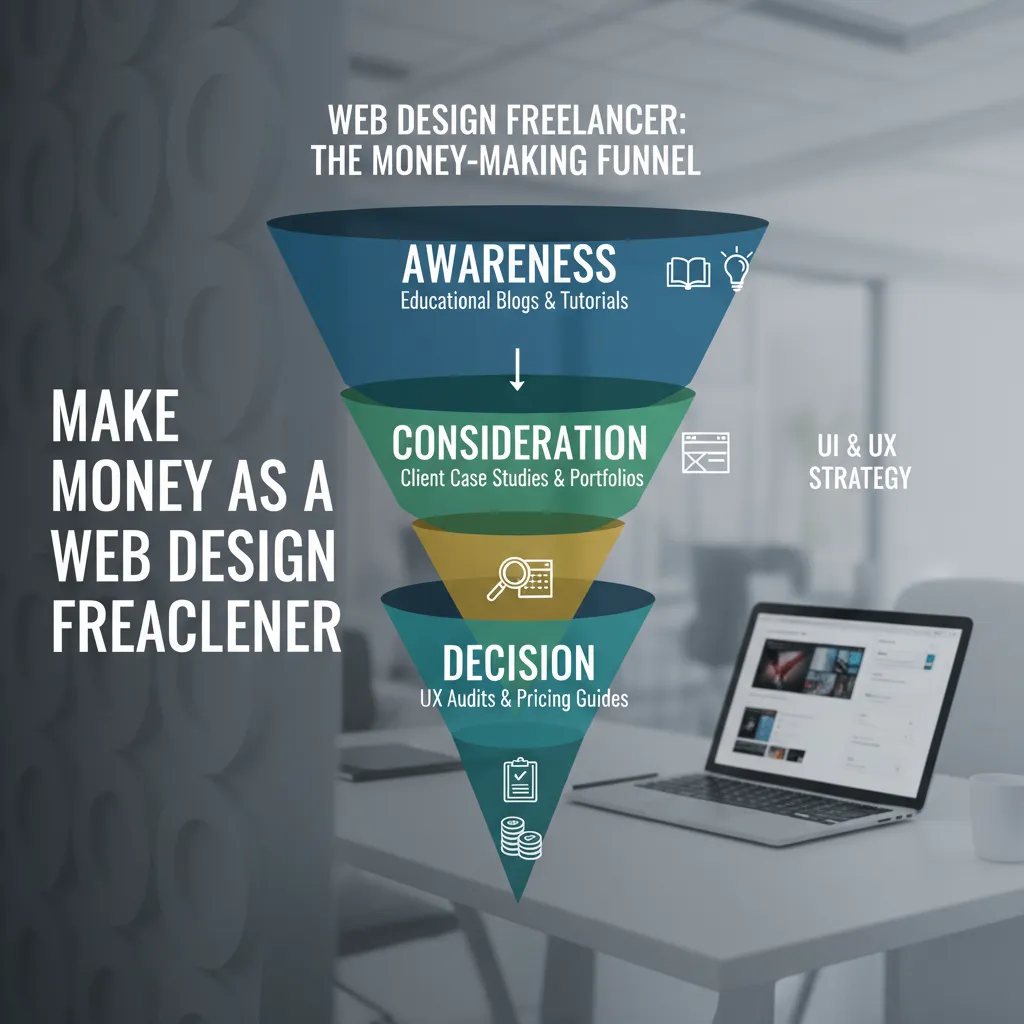
1. Top of Funnel (Awareness): Solving Niche Problems
At this stage, your prospect knows they have a problem (e.g., “my website isn’t selling”), but they don’t know you exist. Your goal is to be the educational resource that defines their problem.
This is where blogging becomes your strongest weapon. It might feel “old school,” but the data contradicts that feeling. According to Orbit Media’s 2024 Blogging Statistics, confirmed by DemandMetric, B2B companies that blog get 67% more leads per month than those that do not.
Content Ideas:
- “Why your SaaS pricing page is losing conversions.”
- “How to hire a designer without wasting your budget.”
- “The cost of a cheap logo in 2025.”
2. Middle of Funnel (Consideration): The Power of Case Studies
Once they trust your expertise, they need to verify your results. This is where most designers fail—they post a gallery of images with zero context. A true case study is a business story, not a design story.
According to the Content Marketing Institute’s 2024 B2B Buyer Behavior Study, 69% of B2B buyers say case studies are the most influential content format when making a purchase decision.
The Focus Lab Strategy: Look at the agency Focus Lab. They don’t just show the logos they made for Asana or Marketo; they write comprehensive, long-form narratives detailing the business impact of the rebrand. They dominate search rankings because they focus on the ROI, not just the RGB.
3. Bottom of Funnel (Decision): Gated Assets
This is the “hand-raising” stage. You trade high-value information for their email address. According to the 2024 Content Preferences Survey by Demand Gen Report, interactive content like calculators and quizzes generates 2x more conversions than passive content.
Lead Magnet Ideas:
- A “Website Conversion Calculator” (Interactive).
- A PDF checklist: “The 10-Point UX Audit for FinTech Apps.”
- A transparent Pricing Guide (e.g., “What does a $15k website look like?”).
Designing High-Converting Lead Magnets
I often see designers hesitate to “give away” their secrets. They worry that if they tell a client how to audit their own website, the client won’t hire them. In my experience, the opposite happens. When you show the complexity of the work, the client realizes they don’t have the time or skill to do it themselves.
A fantastic example of this is the “Rebranding ROI” whitepaper approach. By writing an authoritative document on how rebranding impacts valuation, you attract CEOs looking to exit or raise capital—the exact type of high-ticket client you want.
“Your design portfolio gets them to the door; your writing gets them to open it. Case studies must be business stories, not design stories.” — Morgan Rapp, Creative Coach

Distribution Channels That Actually Work for B2B Design
Creating content is only half the battle. If you build it, they will not come—unless you distribute it. Here are the channels providing the best ROI for designers right now.
LinkedIn: The CEO’s Playground
If you are selling B2B design services, Instagram is a vanity metric; LinkedIn is a bank account. You aren’t trying to impress other designers; you are trying to impress Marketing Directors and Founders.
The data is overwhelmingly in favor of this platform. According to LinkedIn Marketing Solutions’ 2024 B2B Marketing Benchmark, 80% of B2B leads come from LinkedIn. It is the top channel for design agencies targeting businesses.
Strategy: Don’t just post a link to your blog. Write a “micro-blog” post on LinkedIn that summarizes the key takeaway, then link to the full article in the comments or bio. Engage with the founders of companies you want to work with—not by pitching, but by adding value to their conversations.
The Video Advantage
Design is visual, yet many designers are camera-shy. This is a massive missed opportunity. Video builds trust faster than text because clients can see your face and hear your articulation.
According to Wyzowl’s State of Video Marketing 2024, 91% of businesses now use video as a marketing tool, and 87% of marketers say video has directly increased sales. You don’t need a cinema camera; a simple Loom video walking through a design decision can be a powerful piece of content.
Repurposing: The “One-to-Ten” Method
You are busy designing, so you don’t have time to write fresh content daily. The solution is repurposing. Take one deep-dive case study (2,000 words) and turn it into:
- 1 Newsletter email.
- 5 LinkedIn text posts (pulling out quotes).
- 3 Instagram carousels (summarizing the visual process).
- 1 YouTube video (walking through the project files).
Measuring Design ROI: Metrics That Matter
How do you know if this is working? You need to track the right metrics. “Likes” on Dribbble do not pay the rent. You need to look at “Consumption Metrics” and “Conversion Metrics.”

Tracking Time on Portfolio: If users are spending 10 seconds on your case study page, your copy isn’t hooking them. If they spend 3 minutes, they are reading. High “Time on Page” usually correlates with higher inquiry quality.
Automation is Key: You cannot manage this manually. According to Semrush’s State of Content Marketing 2024 Global Report, 67% of small agency owners use AI for content marketing or SEO to scale production without increasing headcount. Use tools to schedule your posts and a simple CRM to track where your leads are coming from.
“Consistency is the only algorithm that matters. You don’t need to post daily, but you must post reliably.” — Ann Handley, Chief Content Officer at MarketingProfs
5 Content Marketing Mistakes Design Agencies Make
In my analysis of hundreds of design portfolios, I see the same patterns of failure repeated. Avoid these to stay ahead.
1. The Echo Chamber Effect
Designers love impressing other designers. We use jargon like “kerning,” “white space,” and “brutalism.” Your client, the owner of a law firm or a dental practice, does not care. They care about “readability,” “trust,” and “customer flow.” Stop writing for your peers.
2. Ignoring Technical SEO for Visuals
Google cannot “see” your images the way a human does (yet). If you upload an image named `DSC00495.jpg`, you are telling Google nothing. Rename your files to `fintech-app-ui-design-dark-mode.jpg`. Add Alt Text that describes the business value of the image. This helps you rank in Google Images, which is a surprisingly high source of traffic for visual services.
3. No Clear Call to Action (CTA)
I am shocked by how many portfolios end a project with… nothing. No “Book a Call,” no “Download our Guide.” You must tell the user exactly what to do next. If you don’t lead them, they will leave.
Frequently Asked Questions
While you can get clients via word-of-mouth, a blog is the only way to get organic leads while you sleep. As noted earlier, B2B companies that blog generate 67% more leads. It is an asset that compounds over time.
Quality beats quantity. One high-value, SEO-optimized case study per month is worth more than daily low-effort social media posts. Aim for consistency—if that means once a week, stick to once a week.
For B2B (agencies and corporate clients), it is undeniably LinkedIn. For B2C or highly aesthetic brands (e.g., packaging design for beverages), Instagram and Pinterest are still viable.
By writing about the process and the results. Cheap designers talk about tools (Photoshop, Figma). Expensive designers talk about outcomes (Revenue, Brand Equity). Your content establishes your authority, which justifies the premium.
Conclusion: Your Content is Your 24/7 Sales Rep
The days of relying solely on a pretty portfolio are over. The market is too saturated, and the competition is too fierce. But this is actually good news for you.
Most designers will refuse to do the hard work of writing, strategizing, and distributing content. They will stay stuck in the “feast or famine” cycle. By building a content ecosystem—starting with educational blogs, moving to ROI-focused case studies, and capturing leads with valuable assets—you separate yourself from the commodity market.
You don’t need to be a professional writer to start. You just need to be a professional problem solver who is willing to share how you solve those problems. According to the Content Marketing Institute’s B2B Benchmarks 2024, 78% of marketers who report extreme success have a documented strategy. Be part of that 78%.
Start today. Pick one question your last client asked you, write a detailed answer, and post it on LinkedIn. That is how you build a pipeline that outlasts any trend.