How to Start a Freelance Web Design Business in 2025
The AI-Augmented Roadmap: Moving from “Generic Coder” to High-Paid Specialist
Table of Contents
- The Shift: Why the Old Way is Dead
- Step 1: The 2025 Mindset Shift (Specialist vs. Generalist)
- Step 2: Financial & Legal Foundations (The Anti-Zombie Contract)
- Step 3: Building a “Conversion-First” Portfolio
- Step 4: The Tech Stack: AI & No-Code Tools
- Step 5: Client Acquisition Systems
- Step 6: Scaling to Recurring Revenue
- Frequently Asked Questions
If you’re reading this thinking that starting a web design business in 2025 means learning to code HTML from scratch and selling generic $500 websites, stop right now. That version of the industry is gone.
In my experience working with designers over the last decade, I’ve watched the landscape shift dramatically. We are now in the era of the “AI-Augmented” designer. The barriers to entry have lowered, but the barrier to profitability has risen. To succeed today, you cannot just build websites; you must build business assets.
The opportunity is massive. According to SkyQuest Technology Consulting’s Global Market Insights 2024, the global web design market is projected to grow from $49.93 Billion in 2024 to over $55 Billion in 2025. Yet, the freelancers capturing this wealth aren’t the ones with the best coding skills—they are the ones with the best business operations.
This article is your operational manual. We aren’t just covering color theory; we are covering contracts, specific 2025 market data, and the legal nuances that separate a hobbyist from a six-figure business owner.
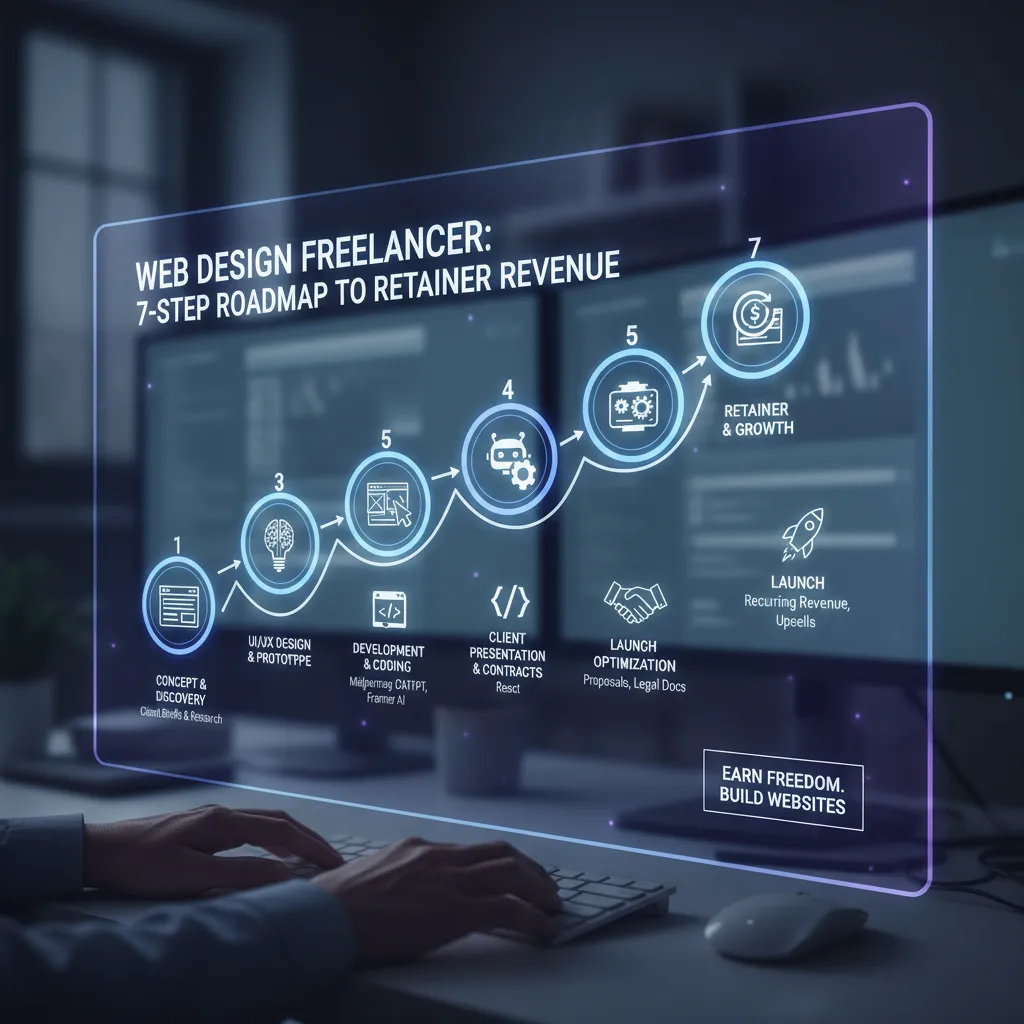
Step 1The 2025 Mindset Shift: Specialist vs. Generalist
Here is the brutal truth: The “I do everything for everyone” model is a fast track to burnout. In 2025, generalists are competing directly with AI website builders that can spin up a generic site in seconds. You cannot win a race to the bottom against a machine.
Why “Full-Stack” is Losing to “Niche-Specific”
Data from an Imperial College London / Freelancer.com Study (2024) indicates a significant shift: there has been a 21% drop in demand for generic web design, while demand for specialized, complex application design is skyrocketing.
When I first started, I took every job that came my way. Pizza shops, law firms, dog walkers. It was a nightmare. I had to learn new industry standards for every single project. When I switched to focusing exclusively on one sector, my efficiency tripled, and so did my rates.
Generalist: Competes on price. Average rate: $45/hr.
Specialist: Competes on value. Average rate: $120+/hr.
Source: Derived from ZipRecruiter / Upwork Salary Data 2024 which shows top 10% earners exceed $120k/year.
Selecting Your Profitable Niche
Don’t just pick a niche you “like.” Pick a niche that has money and a painful problem. In 2025, look for industries that are being forced to digitize rapidly.
- Web Design for HVAC/Trades: High transaction value, usually terrible existing sites.
- FinTech UI/UX: Requires high trust and security features.
- Medical/Telehealth: Exploding growth, requires accessibility compliance (ADA).
Step 2Financial & Legal Foundations (Don’t Skip This)
Most creative types ignore this section. Please don’t. This is what keeps you out of court and ensures you actually get paid.
Business Structure: LLC vs. Sole Proprietorship
While a Sole Proprietorship is free to start, it exposes your personal assets (car, house, savings) to business liabilities. In the US, forming an LLC (Limited Liability Company) is the standard for professionalism and protection.
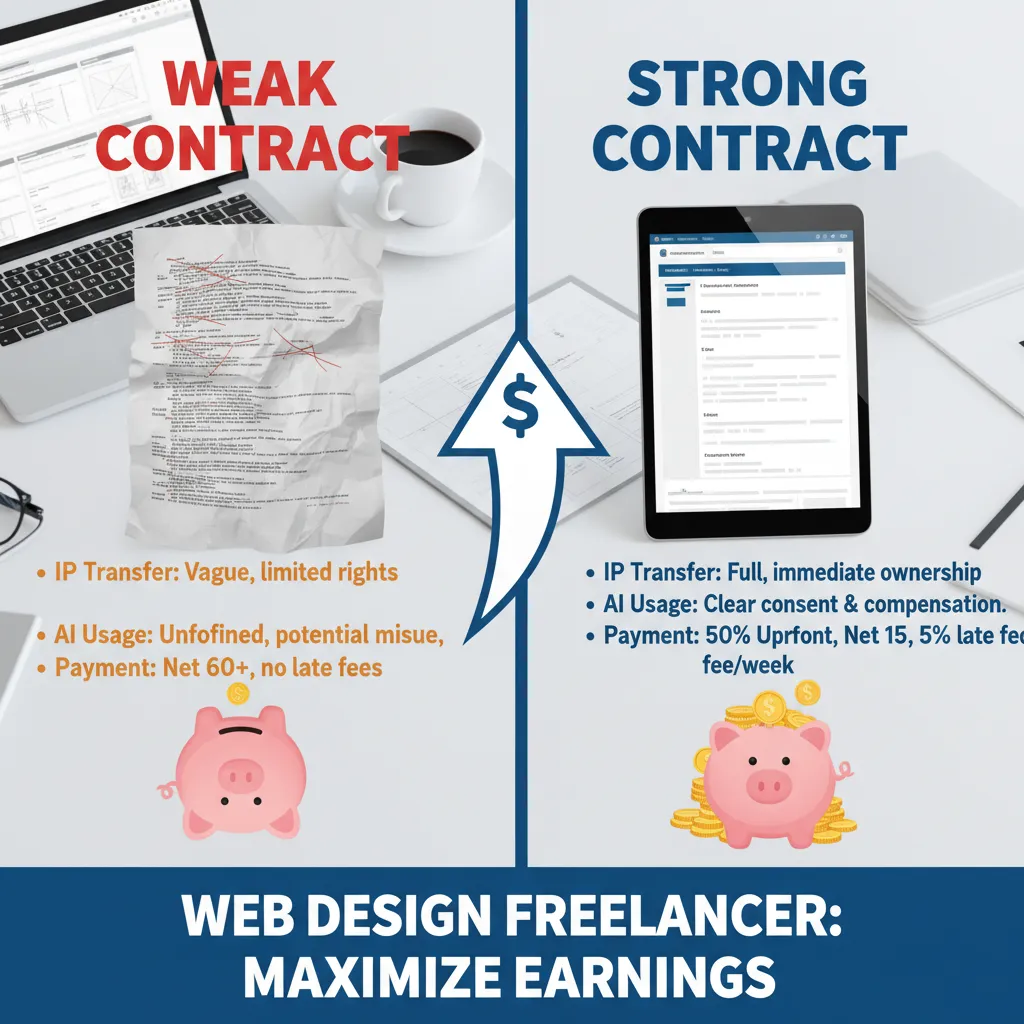
The “Anti-Zombie” Contract
One of the biggest issues freelancers face is “Scope Creep”—where the client keeps asking for “just one more small change.” According to the Squarespace Circle “State of the Web Design Industry” Report 2024, 40% of designers cite managing client expectations and scope creep as their biggest challenge.
To combat this, your contract needs two specific clauses:
- The Scope Creep Cap: Clearly define the number of revision rounds (usually 2-3). Any work beyond that is billed at your hourly rate.
- The “Zombie Project” Clause: This is my favorite. It states that if a client does not respond or provide feedback within 10 days, the project is considered “paused,” and a restart fee is required. If they vanish for 30 days, the project is auto-marked as complete, and the final balance is due.
Pricing Models: Hourly is Out
Hourly billing punishes efficiency. As you get faster with AI tools, you shouldn’t be paid less. Data from the Squarespace Circle Report 2024 shows that 77% of successful designers now prefer project-based pricing over hourly billing to maximize margins.
Use the calculator below to see the difference in earning potential.
Web Design Income Estimator
Step 3Building a “Conversion-First” Portfolio
A common paradox: “I can’t get clients without a portfolio, but I can’t get a portfolio without clients.”
The solution is the Concept Project. You do not need permission to redesign a local business’s terrible website. Do it as a case study. But here is the secret: don’t just make it pretty.
Structure Your Case Studies Like This:
- The Problem: “Local Dentist site was not mobile-friendly, leading to a 73% bounce rate.” (Note: According to GoodFirms Web Design Survey 2024, 73.1% of visitors leave a website due to non-responsiveness).
- The Solution: “Implemented a mobile-first booking system.”
- The Projected ROI: “Estimated increase in booking conversion by 20%.”
Look at the success of Mikolas, a BONT Club member. He went from low-budget hustle to $8,000 – $12,000/month in consistent revenue within 12 months (2024 data) simply by switching his portfolio from “pretty pictures” to “structured, high-ticket offerings.”
Step 4The Tech Stack: AI & No-Code Tools
In 2025, if you aren’t using AI, you are working too slow. The fear that AI will replace designers is fading; instead, it’s empowering them. A report from Influencer Marketing Hub / Freelancer.com Q2 2024 Analysis shows that 52.5% of designers report that AI has either maintained or increased their earnings.
Leveraging AI for Assets
Use tools like Midjourney for custom imagery (avoiding stock photos) and ChatGPT for writing initial copy. I personally use AI to generate “Lorem Ipsum” alternatives—real, relevant text that helps the client visualize the final product better than Latin filler text.
Important Legal Note: You must disclose AI usage. Consumers are actually okay with it—65% of consumers trust businesses that use AI technology for customer interactions/design (Influencer Marketing Hub 2024)—but transparency builds trust.
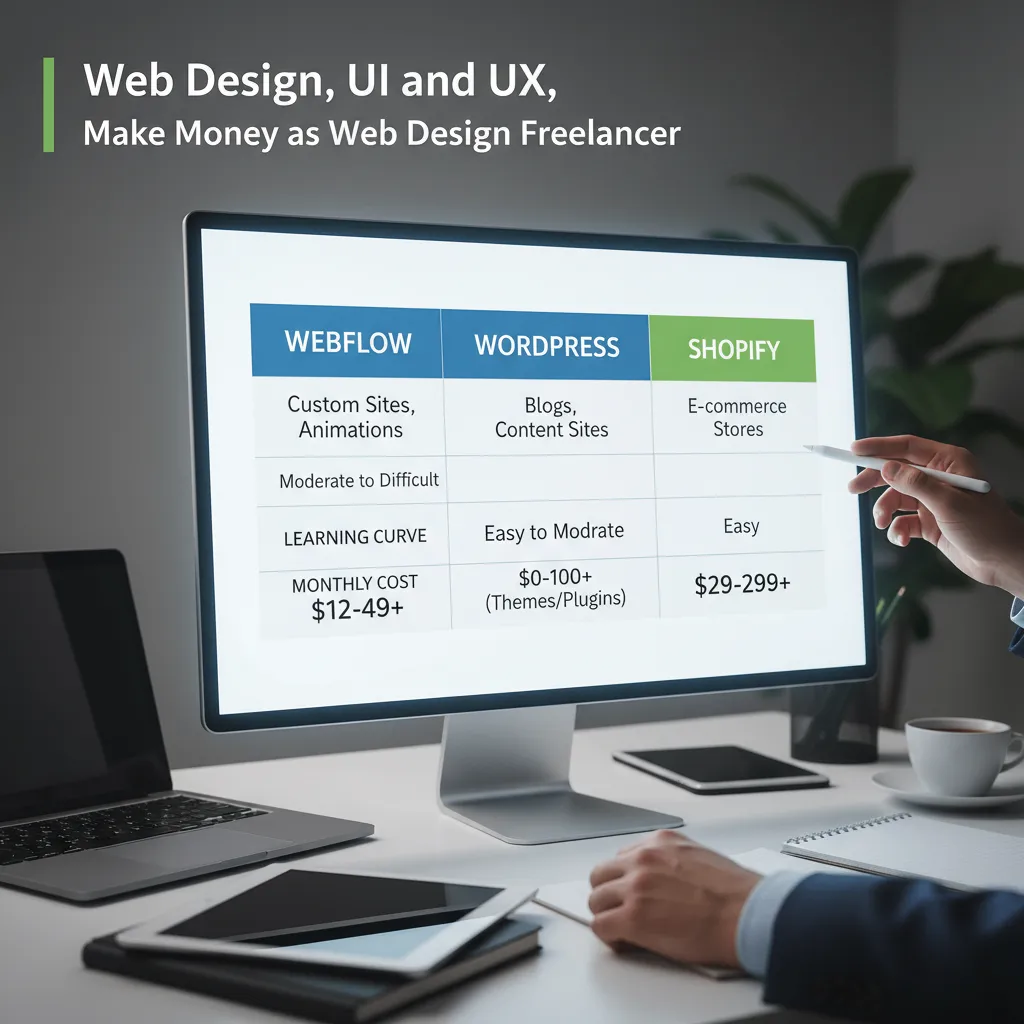
Choosing Your Weapon: Webflow vs. WordPress
- Webflow: The choice for high-end, visual designers who want total control without code. It allows for higher price points due to its clean code and hosting reliability.
- WordPress: Still powers 40%+ of the web. It’s best if you want to use Elementor or Bricks Builder for rapid deployment of local business sites.
Step 5Client Acquisition Systems (Beyond Upwork)
Upwork and Fiverr can be useful, but they are often a race to the bottom. To build a sustainable business, you need your own acquisition channels. Remember, 27% of small businesses still do not have a website in 2024 (Zippia / Webflow Industry Analysis 2024). That is your market.
The “Warm Outreach” Method
Instead of spamming 100 people, send a personalized video audit (using Loom) to 10 local businesses. Point out exactly why they are losing money (e.g., “Your phone number isn’t clickable on mobile”). This provides value upfront.
Partnering with SEO Agencies
This is my favorite “hack.” SEO agencies often have clients with terrible websites that hurt their rankings. They focus on data, not design. By partnering with them, you become their go-to designer for site revamps. You get the referral; they get better results. It’s a win-win.
Consider the Wildnet Technologies Case Study (2024), where design optimization combined with “Intent-Based Keywords” increased a client’s conversion rate by 190%. Use stats like this to pitch your value to potential partners.
Step 6Scaling to Recurring Revenue
The feast-or-famine cycle is the freelancer’s curse. The cure is Recurring Revenue.
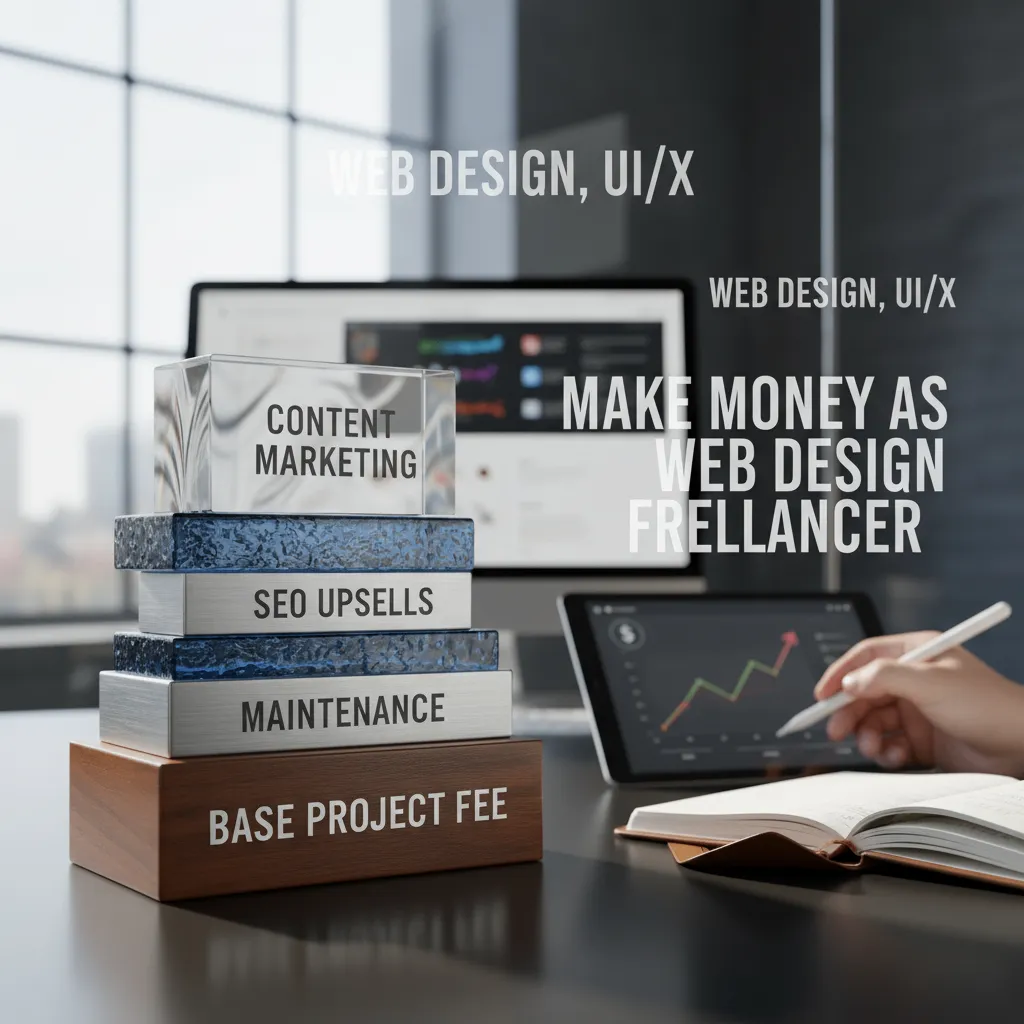
Selling “Website Care Plans”
Once a site is launched, it needs updates, backups, and security checks. Do not give this away. Sell a “Care Plan” for $50-$150/month. If you have 20 clients on a $100 plan, that is $2,000/month covering your rent before you even wake up.
I tell my clients: “You can maintain the site yourself, but if it gets hacked, the cleanup cost starts at $500. Or, you can pay a monthly fee for peace of mind.” 90% choose the fee.
Frequently Asked Questions
Do I need a degree to start a web design business?
Absolutely not. Clients care about your portfolio and your ability to solve their problems. According to the U.S. Bureau of Labor Statistics (2024 Update), while education is noted, the emphasis in the 16% projected job growth is heavily on practical skills and portfolio strength.
How much does a beginner freelance web designer make?
It varies wildly by strategy. Those on Upwork might scrape by with $20k/year. However, the median for established freelancers hovers around $63k-$72k, with the top 10% exceeding $120,000/year (ZipRecruiter 2024).
Is freelance web design still profitable in 2025?
Yes, but the type of profitable design has changed. Selling generic templates is dead. Selling custom solutions, e-commerce integrations, and conversion-focused designs is more profitable than ever due to the $1.5 trillion freelance economy contribution.
Conclusion: The Future Belongs to the Strategic Designer
Starting a freelance web design business in 2024 and 2025 isn’t about mastering the pen tool in Figma. It’s about mastering the business of design. It’s about understanding that a contract is as important as a color palette, and that AI is a tool to accelerate your creativity, not replace it.
The market is growing to $55 billion. There is plenty of room for you, provided you approach this not as a freelancer, but as a business owner. Take the first step today: define your niche, draft your contract, and start building concept projects that prove your value.