Can Soft Skills Boost a Freelance Web Designer? Data Says Yes (Here’s How)
By Content Specialist | Updated 2025
In 2025, AI can write your CSS code in seconds. It can generate a responsive layout faster than you can open Figma. But here is the thing: AI cannot talk a panicked client off a ledge at 10 PM. It cannot negotiate a retainer agreement that doubles your monthly recurring revenue, and it certainly can’t read the room when a stakeholder says “I like it” but their body language screams “I hate it.”
You might be wondering if spending time on “people skills” is really worth it when there are new JavaScript frameworks released every week. I’ve been in this industry long enough to see brilliant coders fail because they couldn’t communicate value, and average designers build six-figure agencies because they mastered the art of the client relationship.
If you feel like you’ve hit an income ceiling, or if you’re constantly battling “scope creep” (where clients ask for just one more small change for free), the solution isn’t learning React. It’s learning how to manage expectations.
This article isn’t just a list of nice-to-have traits. We are going to look at the hard data proving why soft skills are the primary revenue driver for freelancers in the AI era. I’ll provide you with actual copy-paste scripts for difficult conversations and show you exactly how to pivot from a commodity pixel-pusher to a high-value consultant.
The “Hard” Truth About Soft Skills in 2025
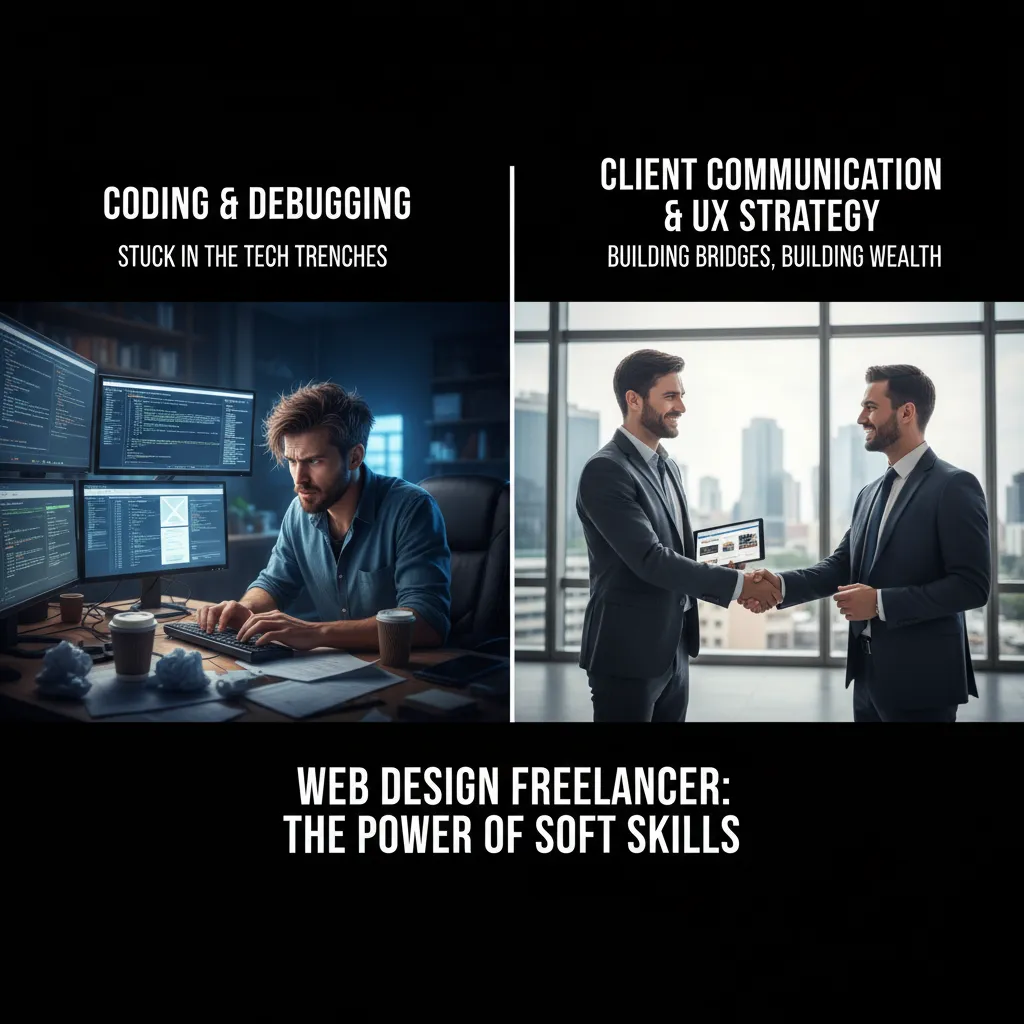
There is a massive misconception in the freelance world that your portfolio is the only thing that matters. While a strong portfolio gets you the interview, it is rarely the thing that closes the high-ticket contract.
The market is currently flooded with technically competent designers. Thanks to no-code tools and AI assistants, the barrier to entry for “building a website” has never been lower. This has led to what I call the “Commoditization of Code.” If you compete solely on your ability to write clean HTML, you are competing in a race to the bottom.
However, the data tells a compelling story about where the real value lies. According to the LinkedIn 2024 Most In-Demand Skills Report, 92% of talent professionals and hiring managers say soft skills are just as important, or more important, than hard skills. In an era where technical tasks are being automated, the “human premium” is skyrocketing.
of job success comes from having well‐developed soft and people skills, and only 15% comes from technical skills.
Source: National Soft Skills Association (Harvard/Carnegie/Stanford Research)
This isn’t just about getting hired; it’s about the income gap. The Upwork Research Institute’s “Freelance Forward 2024” report highlights that freelancers with high client satisfaction ratings—driven largely by communication and reliability—earn significantly more per hour. The data indicates that skilled independent talent earning a median of $85,000 often outpace their full-time counterparts, specifically because they treat their freelance work as a business, not just a task list.
The “Big 5” Soft Skills That Directly Impact Income
So, which skills actually pay the bills? Based on my analysis of current market trends and client feedback loops, these are the five pillars that separate the $50/hour freelancer from the $150/hour consultant.
1. Communication: The Rate Multiplier
Most designers think communication means replying to emails quickly. It’s deeper than that. Effective communication is the ability to translate “client speak” into “dev speak” and back again. When a client says, “Make it pop,” a low-skill designer adds bright colors. A high-skill communicator asks, “What specific emotion are we trying to evoke for the user here?”
Communication is also your primary defense against scope creep. You need to be able to say “no” without sounding like a jerk.
Client: “Hey, can we just quickly add a blog section? It shouldn’t take long.”
You: “I’d be happy to help with that! Since a blog functionality wasn’t in our original project scope, I can write up a separate estimate for that feature. If we move forward with it, it will likely push our launch date back by about three days. Would you like me to send over the quote for that add-on?”
Notice what happened there? You didn’t refuse. You simply attached a price tag and a timeline consequence to their request. That is a soft skill.
2. Emotional Intelligence (EQ) & Empathy: The UX Superpower
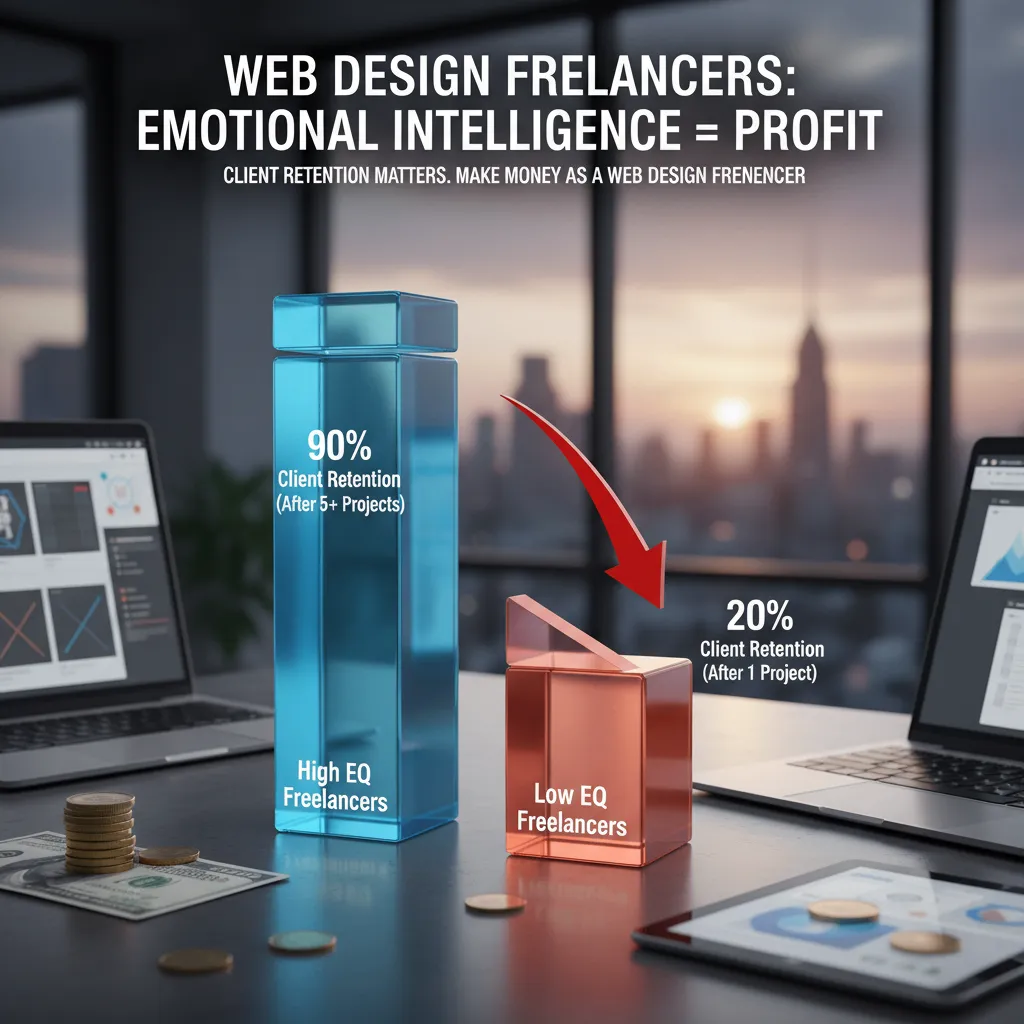
I believe empathy is actually a technical skill in UX design. You cannot build a user-centric product if you cannot feel what the user feels. But beyond the design itself, empathy is critical for client retention.
According to WebFX 2024 Web Design Statistics (citing Forrester Research), 89% of consumers shop with a competitor after a poor user experience. In the freelance context, your client is your user. If their experience working with you is stressful, confusing, or dismissive, they will churn.
3. Negotiation & Sales: The Income Booster
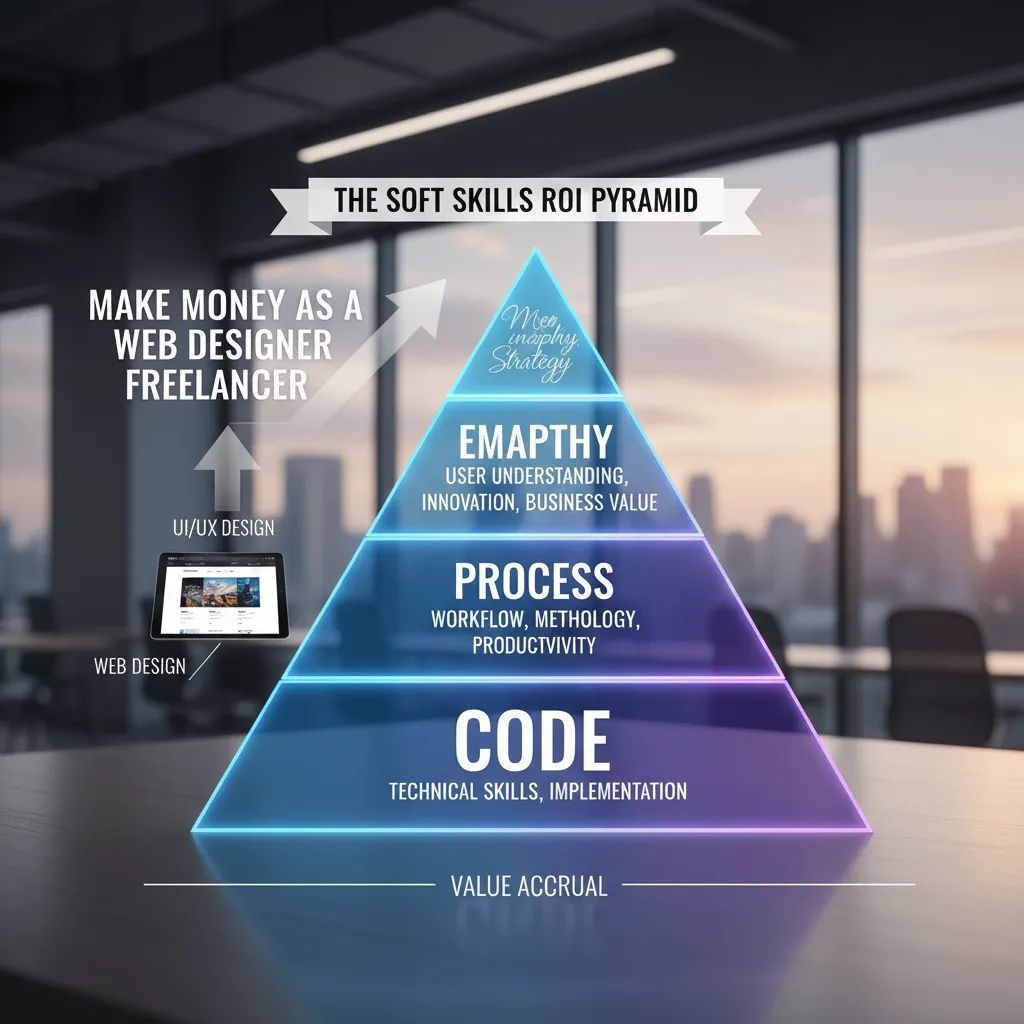
Many freelancers suffer from “imposter syndrome” when discussing money. They view themselves as order takers. To boost your income, you must view yourself as a strategic partner. This requires the soft skill of negotiation—moving the conversation from “cost” to “value.”
“You don’t charge for the time it takes. You charge for the value you create. Value is a conversation, not a pixel.”
When you negotiate effectively, you aren’t arguing about your hourly rate. You are discussing the Return on Investment (ROI) the client will get from your website.
4. Time Management: The Profit Protector
In a traditional job, if you waste an hour, you still get paid. In freelancing, time management is directly linked to your profit margin. If you quoted a flat rate of $2,000 for a website assuming it would take 20 hours ($100/hr), but poor time management drags it out to 40 hours, you have just slashed your own salary to $50/hr.
Tools like Trello or Asana are useless without the discipline to use them. The soft skill here is boundary setting—knowing when to stop tweaking a design and ship it.
5. Adaptability: The Longevity Key
The tech industry moves at breakneck speed. The NACE Job Outlook 2025 reports a significant “skills gap” where employers (and clients) are desperate for problem-solving skills. They want freelancers who don’t crumble when a plugin breaks or when a new Google algorithm update changes the SEO landscape.
Adaptability means you don’t complain about change; you capitalize on it. When AI image generators launched, adaptable designers didn’t protest; they started selling “AI-assisted asset creation” services.
The “Invisible” ROI: How Soft Skills Fix Scope Creep
I want to pause here and address the biggest killer of freelance careers: Scope Creep. This is when the project requirements slowly expand without the budget expanding to match.
Most designers blame the client for this. But honestly? In my experience, scope creep is almost always a failure of the designer’s communication skills. It happens because boundaries weren’t set during the onboarding process.
Let’s look at the financial impact of this. If you lose just 2 hours a week to unpaid “small tweaks” for clients, the loss compounds massively over a year.
💰 Lost Revenue Calculator
Estimate how much “nice” behavior and poor boundaries are costing you.
You are losing per year!
That’s money you worked for but gave away for free due to soft skill gaps.
Seeing that number usually wakes people up. A client asking for “just a quick change” is asking for a portion of your annual salary. The soft skill of assertiveness is the only thing protecting that money.
Data-Backed Case Study: The $50k vs. $100k Freelancer
Let’s illustrate this with a composite case study based on data trends from the Upwork Freelance Forward 2024 report regarding high-earning freelancers.
Freelancer A: “Pixel Paul”
- Technical Skills: Top 1% (Can code anything from scratch).
- Soft Skills: Low. Avoids phone calls, takes feedback personally, replies to emails sporadically.
- The Result: Paul constantly hunts for new clients because his retention rate is near zero. He competes on price on job boards.
- Annual Income: $48,000 (capped by hours worked).
Freelancer B: “Consultant Sarah”
- Technical Skills: Top 20% (Uses Webflow and templates often).
- Soft Skills: High. proactive communication, sets clear boundaries, listens to client business goals.
- The Result: Sarah’s clients put her on retainer. They refer her to other business owners because “she just gets it.” She spends zero time hunting for work.
- Annual Income: $115,000 (recurring revenue).
Sarah earns double what Paul earns, despite having “worse” coding skills. Why? Because clients do not buy code. They buy peace of mind. Sarah provides a stress-free experience; Paul provides a transactional service. As NACE data suggests, the skills gap in the market isn’t technical proficiency—it’s professional maturity.
FAQ: Soft Skills for Web Designers
Q: Can I learn soft skills if I’m naturally introverted?
Absolutely. Being introverted doesn’t mean you can’t communicate. Soft skills are systems, not personality traits. You can create templates for emails, scripts for calls, and processes for feedback. It doesn’t require being the “life of the party”; it requires being organized and clear.
Q: Which soft skill raises rates the fastest?
Negotiation combined with Business Acumen. If you can articulate how your design will make the client money (e.g., “This new checkout flow will likely increase conversions by 15%”), you can charge based on value, not hours.
Q: Do clients really care about the process, or just the result?
For the client, the process is the user experience. According to the Project Management Institute (PMI), 70% of projects fail due to a lack of user acceptance and communication breakdown, not technical bugs. If the process is painful, the client will hate the result, no matter how pixel-perfect it is.